What a Crypto Backtest Could Actually Know: Missing Data, Time Joins, and Historical Revisions
An empirical audit of archived lending and price observations
Data vintage April–May 2026 archive observations; verification performed October 2026
Abstract
Historical data can describe past states accurately while still being unsuitable for evaluating decisions made at those times. This article audits an archived collection of lending-reserve and token-price observations to distinguish state reconstruction from information availability. Among 3,436 planned asset-block observations across five Aave markets, 51 lack a complete supply-and-debt pair. All missing pairs occur in Ethereum Core, where they represent 3.10% of planned observations; a successful-row CSV omits them. None of the valid reserve rows duplicates the same market, asset, and block. In a separate price transformation, nearest-time matching pairs 778 of 790 rsETH observations with a WETH source timestamp in the future relative to the rsETH timestamp. The median forward offset is 60 seconds. A backward join removes this particular time-ordering problem while leaving historical receipt times unknown. A clearly synthetic delayed-observation example demonstrates how backfilling can advance an apparent alert by one minute without improving the information available to a live process. The article develops a reproducible audit framework covering coverage denominators, observation semantics, selection, revision history, and point-in-time joins. It reports no trading-performance estimate.
Keywords: point-in-time data; backtesting; look-ahead bias; data quality; missingness; timestamps; revisions; DeFi.
1. Historical truth and available information
A backtest makes a claim about what a decision rule could have done. A historical chart makes a claim about what an analyst can reconstruct now. The underlying observations can overlap, but the claims require different evidence.
Suppose a provider reconstructs an April reserve balance in September. The balance may correctly describe the April blockchain state. It does not follow that a trading process received that balance in April, received it without delay, or knew the provider's eventual interpretation of the field. An event-time index alone cannot answer those questions.
The distinction between event time and processing time is established in stream-processing research. The Dataflow model treats their divergence and late-arriving observations as explicit properties of a computation. Here, that distinction is applied to financial research: a backtest must state which information clock controls the admissible observations. Akidau et al., The Dataflow Model.
This article asks what a modest archive audit can establish before a strategy or risk model is evaluated. It uses observed defects and constraints in existing data, rather than assuming that every archive is either complete or unusable. The objective is to assign each dataset to the questions its retained evidence can support.
2. Audit design and definitions
The audit uses two collections. The first consists of raw historical reserve-state responses for five Aave markets. The second contains vendor chart prices for USDe, sUSDe, rsETH, and WETH, accompanied by a transformation that computes an rsETH/WETH ratio.
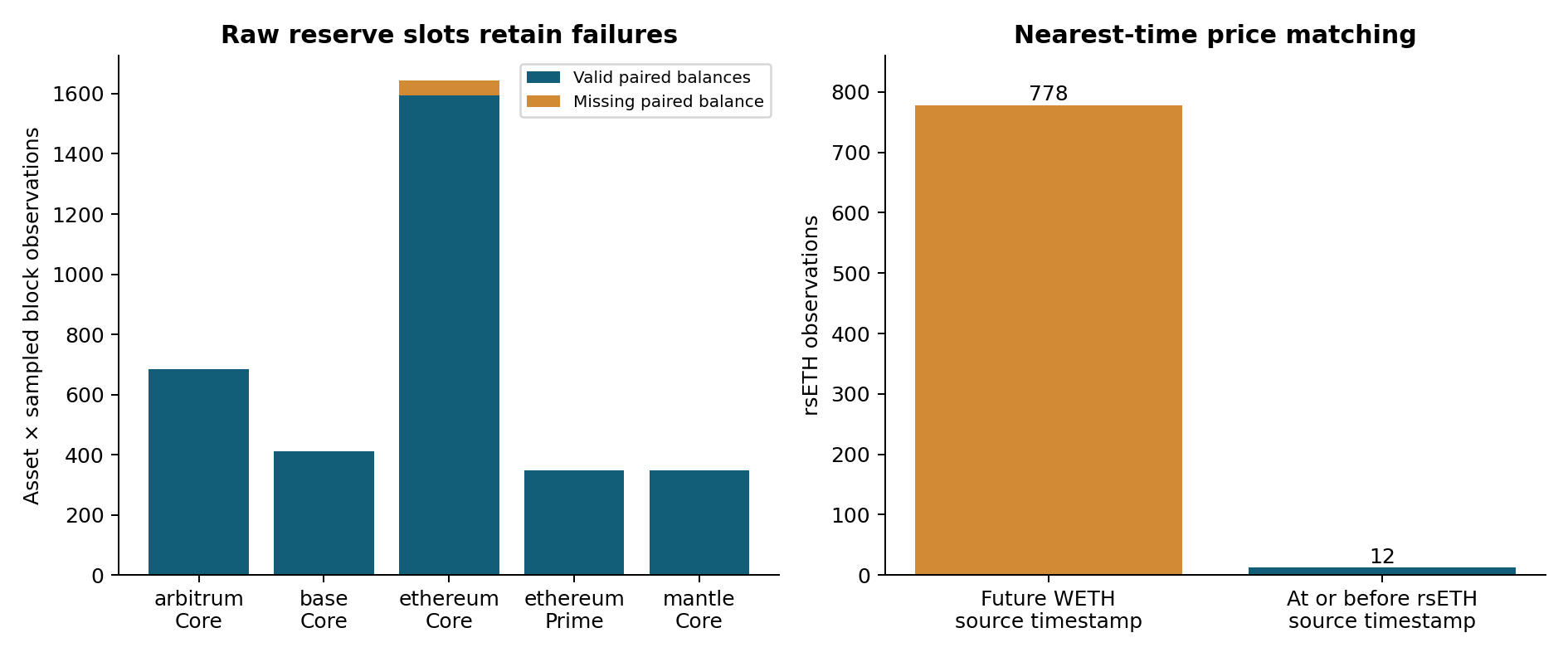
For each reserve market, the planned denominator is the set of asset entries present at every saved sampling block, including entries with failed supply or debt fields. An observation is valid for the audited ratio only if both raw integer supplies are present. This denominator measures the collector's retained schedule. It does not estimate every observation that might have existed between sampled blocks.
A reserve duplicate means a repeated (market, asset, block) key among valid observations. A price duplicate means an identical source timestamp within one symbol. These definitions do not collapse economically different records merely because they share a rounded hour or a numeric value.
For the price grid diagnostic, timestamps are assigned to the nearest whole UTC hour using floor((timestamp + 1800) / 3600). The number of unoccupied slots is measured between each series' first and last assigned hour. This is a declared regularization convention, not proof that the provider promised a value at every such hour.
All public audit outputs contain aggregate counts, sampling intervals, and synthetic observations. Account rows, wallet identifiers, private labels, and individual trading histories are excluded. Source-file hashes and the exact audit procedure are retained in the verification record.
3. Result one: successful-row exports hide the missing denominator
| Market | Planned asset-block observations | Valid pairs | Missing pairs | Missing share | Duplicate valid keys |
|---|---|---|---|---|---|
| Arbitrum Core | 685 | 685 | 0 | 0.00% | 0 |
| Base Core | 411 | 411 | 0 | 0.00% | 0 |
| Ethereum Core | 1,644 | 1,593 | 51 | 3.10% | 0 |
| Ethereum Prime | 348 | 348 | 0 | 0.00% | 0 |
| Mantle Core | 348 | 348 | 0 | 0.00% | 0 |
| Total | 3,436 | 3,385 | 51 | 1.48% | 0 |
Table 1. Original audit of the raw reserve archive. Validity requires both aToken supply and variable-debt supply. Coverage concerns saved sampling blocks, not every block in the period.
The Ethereum Core transformation exports only entries with a non-null computed ratio. Its resulting CSV has 1,593 rows and no rows representing the 51 failed pairs. A reader inspecting that CSV alone could describe it as containing no null ratio values while overlooking incomplete collection.
The omission is not inherently wrong for a convenience table. The problem arises when the successful-row table is treated as the sampling manifest. A coverage calculation requires both successes and failures, ideally linked to the planned requests. Otherwise, a file can become “complete” simply by excluding everything that failed.
Some raw entries retain one integer supply while the other is null. Such a record has partial information. It cannot support the paired ratio, but it can still help diagnose the collector's failure mode. Replacing it with an all-zero record would assert a state not observed; deleting it without a coverage record would erase evidence about reliability.
Zero duplicates are also a limited finding. They establish uniqueness under the audited key. They do not demonstrate complete coverage, correct asset labeling, simultaneous collection, or economic accuracy. Quality dimensions must be measured separately rather than summarized as one binary “clean” flag.
4. Result two: nominally hourly prices do not form a complete hourly panel
| Price series | Observations | Distinct source timestamps | Rounded-hour slots | Unoccupied slots | Largest source-time gap |
|---|---|---|---|---|---|
| USDe | 791 | 791 | 793 | 2 | 3 h 00 m 15 s |
| sUSDe | 729 | 729 | 793 | 64 | 3 h 51 m 31 s |
| rsETH | 790 | 790 | 793 | 3 | 2 h 59 m 58 s |
| WETH | 790 | 790 | 792 | 2 | 2 h 59 m 58 s |
Table 2. Price-grid diagnostics under the explicitly defined nearest-hour convention. Endpoints differ by symbol. No series has more than one observation assigned to the same rounded-hour slot in this archive.
The sUSDe series occupies 729 of 793 regularized slots, approximately 91.9%. That is materially different from assuming that an hourly request produced an uninterrupted hourly series. It does not establish whether unoccupied slots arose from collection failures, upstream observation cadence, provider selection rules, or another mechanism.
The missingness mechanism matters. A pricing source can update differently for a slowly changing exchange rate than for a frequently traded asset. Provider congestion can also correlate with market stress. The archive lacks enough provenance to distinguish these explanations, so missing observations are not assumed to be missing at random.
Forward filling a price across a gap imposes a persistence assumption. It may be appropriate for a field that legally or contractually remains in force until updated, but it is a modeling choice for an intermittently observed market price. The filled record should retain the age and identity of the last observed value.
Linear interpolation uses observations on both sides of a gap. It can be useful for a retrospective visualization while leaking future information into a decision-time test. A smooth line and a valid executable signal are different products. Their transformations should carry different labels even if they originate from the same source file.
5. Result three: nearest-time matching usually selected a later observation
The saved price transformation chooses the WETH observation closest in absolute time to each rsETH observation, subject to a maximum one-hour distance. This is a common descriptive alignment rule. It is not a rule that guarantees historical availability.
In 778 of the 790 rsETH observations, or 98.48%, the selected WETH timestamp is later than the rsETH timestamp. The median positive offset is 60 seconds and the maximum is 85 seconds. The high frequency largely reflects a systematic difference in source timestamp placement; it does not mean that each row is hours out of sequence.
A backward sensitivity join instead selects the most recent WETH observation with source timestamp no later than the rsETH timestamp and a maximum age of one hour. It retains 785 ratios. Over those shared valid rows, the largest relative difference between the nearest and backward ratios is approximately 394 basis points, or 3.94%.
The larger ratio difference can arise because a one-minute ordering difference determines whether the matched WETH price comes from the nearby hour or the preceding hour. This is why a small timestamp offset need not imply a negligible valuation difference during a volatile period.
The difference between nearest and backward joins is explicit in standard tools: a nearest join minimizes absolute key distance, while a backward join selects the latest eligible key at or before the target. Choosing the direction is therefore part of the research specification. pandas, merge_asof documentation.
A backward source-time join alone does not remove all look-ahead. A value stamped at 12:00 can arrive at 12:05. A process deciding at 12:01 could not use it, even though its source timestamp is earlier. Conversely, two values with slightly different source timestamps might both be available before a deliberately delayed decision. The correct admissibility condition depends on the decision clock and actual delivery history.
For the specific rsETH incident thresholds examined in the companion event study, both tested joins locate the first observed 5% and 10% discounts at the same retained timestamps. That agreement is a robustness result for those thresholds. It does not justify treating every derived ratio as simultaneous or establish strategy-level performance.
6. A synthetic example of manufactured early warning
Consider five constructed observations, with no connection to a real asset or realized return. A monitor alerts when the latest available value falls below 80.
| Event minute | Recorded value | Minute first available to the monitor |
|---|---|---|
| 0 | 100 | 0 |
| 1 | 100 | 1 |
| 2 | 70 | 5 |
| 3 | 70 | 3 |
| 4 | 70 | 4 |
Table 3. Synthetic delayed-observation example. The minute-2 record is unavailable until minute 5.
A retrospective event-time chart shows the threshold crossed at minute 2. A monitor using only information actually available first sees a qualifying value at minute 3. If the late record is inserted into the historical table without preserving its availability time, a subsequent backtest can report an alert one minute earlier than the live process could have generated.
The backfill improves the reconstruction of the event-time series. It does not improve the monitor's historical information set. Both views can be valid for their own purposes if they are explicitly labeled and reproducible.
Formally, let a_i be the first usable availability time of observation i, e_i its event time, and v_i its value. The admissible information set for a decision at T is:
I(T) = { (e_i, v_i, version_i) : a_i <= T }
If the application uses the most recent event among available observations, it selects the maximum eligible e_i within I(T). A newly arrived older event can amend historical analysis without replacing a fresher current-state observation. Out-of-order delivery therefore requires an explicit update rule as well as an availability filter.
This example demonstrates timing leakage only. It does not simulate execution, slippage, or investment returns, and the apparent extra minute is not a claimed profit opportunity.
7. Semantic checks can matter more than missingness
The reserve audit finds 399 valid observations where aToken supply minus variable debt is negative. This is 11.79% of the 3,385 valid pairs. The count includes different assets and sampling times across the five markets.
The arithmetic can be reproduced, but labeling the result “withdrawable cash” would be misleading. It is a difference between two accounting quantities, and the necessary reconciliation to actual underlying balances is not present. A field can be complete, unique, and arithmetically correct while carrying an invalid economic interpretation.
The same issue applies to prices. An oracle answer, a last trade, a vault exchange rate, and a sale quotation for a specified quantity are distinct measurements. Chainlink's documentation describes update thresholds and historical rounds; an apparently stale value must be assessed against the feed's semantics and update policy. A market-price freshness rule should not be applied mechanically to every accounting exchange rate. Chainlink, Getting Historical Data.
Sampling rules require similar care. The archived account collector discussed in article 08 filters balances above 100,000 token units, although a comment describes a dollar cutoff. An audit that reads only the label would propagate the wrong sample definition. Code, units, and the resulting observation set must agree.
8. A reproducible contract for research data
A useful observation schema separates what the record describes from when it became usable. The following fields form a practical research specification rather than a claim that the audited archive already contains them:
| Field or record | Research purpose |
|---|---|
| Event or state time | Places the economic observation in history |
| Source timestamp and clock definition | Records what the upstream system actually timestamps |
| First observed and first usable time | Bounds the decision process's historical information |
| Chain, block number, and block hash where applicable | Identifies the queried state and permits reorganization checks |
| Source, schema version, and transformation version | Makes field interpretation and changes traceable |
| Quality state and failed-request manifest | Preserves coverage denominators and partial failures |
| Revision identifier and superseded version | Separates corrected history from previously delivered data |
| Units, valuation type, and maximum allowed age | Makes economic and temporal assumptions explicit |
For blockchain reconstruction, a block number helps identify historical state, but a block hash can further disambiguate state across reorganizations. EIP-1898 specifies hash-based references and an optional canonical-chain requirement for affected RPC methods. Whether a particular provider supports those semantics must be verified operationally. Ethereum, EIP-1898.
For delivered datasets, retain two reproducible views when feasible: the latest corrected historical view and the view available by a specified delivery cutoff. Revision history should describe which values changed, their reasons, and when users could first access the changes. Replacing a file in place erases this distinction unless previous versions and delivery records remain accessible.
Provider documentation can also constrain the appropriate claim. Hyperliquid's historical-data documentation states that archive updates are not guaranteed to be timely and data can be missing. That is a reason to measure delivery and coverage directly, rather than infer them from a file's existence. Hyperliquid, Historical Data.
9. What the audit establishes
The audited archive supports useful descriptive research. Raw integer balances permit arithmetic reconstruction; retained failure slots expose an otherwise hidden missing denominator; price timestamps permit a direct test of alignment choices. These are substantive strengths alongside the limitations.
It does not preserve enough receipt and revision information to reproduce an April live monitor's complete information set. Accordingly, a study using these files can describe reconstructed states and test sensitivity to modeling choices, but cannot label the result an exact replay of historically available information.
There is no single cleaning operation that resolves every limitation. Deduplication addresses repeated keys, backward joins address one ordering rule, and backfills address some missing historical observations. Each operation requires a declared purpose and can leave other problems unresolved.
A high-quality research dataset makes those boundaries observable. Its value lies partly in the measurements themselves and partly in the ability to determine which claims the measurements support, reproduce the calculation, and identify where additional evidence is required.
Data availability and reproducibility
This web article presents the reserve coverage audit, price-grid audit, time-join audit, synthetic delayed-observation example, and figure. The retained aggregate files preserve the denominators used in the tables, and the retained synthetic file is explicitly labeled in every row.
The verification procedure reads the retained raw archive, counts failures before filtering, checks key uniqueness, computes price joins directly from timestamps, and generates the figure. It does not silently repair source files or publish account records. The reported findings describe this archive and should not be generalized to every market-data source.