When Market Prices and Oracle Prices Diverge: A Framework for Liquidation Risk
An archived Aave case study separating valuation, eligibility, and execution
Data vintage Archive described as 10 July 2026; account requests were not pinned to a common block
Abstract
A decline in a collateral token's market price does not, by itself, identify a liquidation event. Liquidation depends on the valuation function used by the lending protocol, account balances, applicable risk parameters, and the feasibility of executing a liquidation transaction. This article develops a framework that distinguishes market equity, oracle-based health factor, and liquidator profitability. An original audit of an archived Aave sample finds 98 distinct account records, 82 with positive recorded debt. Fifty-five of those borrowing records have a reported health factor between 1.0 and 1.1. Their presence establishes sensitivity to protocol valuation changes, while leaving sensitivity to a particular market-price shock unresolved. Stored reserve prices for USDe and sUSDe imply a relative valuation of approximately 1.2386, but the saved observations cannot independently establish the complete historical oracle implementation. A constructed balance-sheet experiment shows how a constant valuation function can leave health factor unchanged as market equity falls, and how an oracle adjustment can establish eligibility without ensuring profitable execution. The contribution is a reproducible measurement framework and a bounded empirical account of the archive, without identifying individual accounts or representing modeled losses as realized protocol deficits.
Keywords: Aave; USDe; sUSDe; oracle; health factor; liquidation; collateral valuation; execution risk.
1. Three questions hidden inside one price chart
A collateral-price chart is often used to answer three different questions: whether a borrower is economically solvent, whether the protocol permits liquidation, and whether someone can profitably execute that liquidation. The answers can differ at the same moment.
Economic solvency concerns the value obtainable from assets relative to obligations. Protocol eligibility concerns the precise valuation and risk rules used by the contract. Execution concerns the price, quantity, fees, and settlement conditions available to a liquidator. Combining these into a single “liquidation price” conceals the assumptions that connect them.
Aave's documentation defines health factor using collateral value, the weighted liquidation threshold, and debt value; a health factor below one indicates liquidation eligibility, subject to applicable protocol conditions. This article uses that definition without importing today's close-factor or dust rules into an unpinned historical sample. Aave, Health Factor & Liquidations.
The empirical question is deliberately narrow: what do the retained account and reserve observations establish about oracle-based exposure, and what information remains necessary to infer the consequences of a collateral-market discount? The analysis does not estimate current Aave risk, predict a stablecoin failure, or attribute positions to particular people or firms.
2. Archive construction and sample limitations
2.1 The executable selection rule
The archive contains 98 distinct account records selected by a collector examining recipients of transfers in four USDe-related aToken contracts. The collector then queried balances and retained accounts with more than 100,000 token units in at least one of the tracked balances.
The denomination matters. The implemented filter compares token units with 100,000; it does not compare dollar valuations with USD 100,000. A yield-bearing share with an exchange rate above one therefore faces a different dollar threshold from a unit-priced token. Interpreting this as an identical monetary cutoff would misdescribe the sample.
The transfer scan also uses a fixed block interval, while the subsequent balance and account-data calls request latest. Account data, efficiency-mode status, and individual debt-asset responses are collected in separate batches. The saved file does not retain a common block reference or per-response receipt time. Its accompanying description dates the archive to 10 July 2026, which is treated here as an archive label, rather than proof that every field describes one simultaneous state.
Ethereum's RPC specification allows calls at an explicit block or a moving block tag. That choice determines the state being queried. A sequence of latest requests cannot be assumed to share a block merely because the requests belong to one script. Ethereum, JSON-RPC API.
2.2 Observations and interpretation
The stored account fields include total collateral value, total debt value, an average liquidation threshold, and a reported health factor. The account-level totals can include collateral outside the four assets used for selection. Consequently, a record's total collateral is not automatically its USDe-family exposure.
The separate reserve file stores supplied units and oracle prices for a set of USDe-related assets. A reserve's total supplied units include balances that may not all be enabled as collateral. Multiplying supply by the stored price produces a reserve valuation; it does not reconstruct account collateral eligibility.
No probability sampling scheme is available. The analysis reports the observed sample directly, without extrapolating it to all borrowers. Public outputs contain only broad counts, overall sample totals, reserve totals, and explicitly synthetic scenarios. Every disclosed account-count category contains at least ten records. No account identifiers, account-level balances, or participant classifications are released.
3. Formalizing the valuation problem
For an account with collateral quantities q_j, debt quantities b_k, collateral oracle prices O_j, debt oracle prices O_k, and applicable collateral liquidation thresholds λ_j, define:
Oracle collateral value C_O = Σ_j q_j O_j
Oracle debt value D_O       = Σ_k b_k O_k
Health factor H            = (Σ_j λ_j q_j O_j) / D_O
The formula requires collateral eligibility and the account's applicable configuration. A reserve's ordinary parameter does not necessarily equal the parameter applicable to an account using a special risk category. A time series also needs parameter changes, accrued debt, balance changes, and the relevant price-source implementation.
For economic valuation, replace oracle prices with executable or otherwise explicitly defined market valuations M:
Market equity E_M = Σ_j q_j M_j − Σ_k b_k M_k
A negative E_M under a stated valuation convention is a modeled shortfall. It is not equivalent to a recorded reserve deficit, an unpaid debt after liquidation, or an ultimate loss borne by suppliers. Those outcomes depend on execution, recoveries, timing, and protocol accounting.
Even M requires a definition. A last trade, a pool spot quote, and proceeds from selling a large collateral quantity are distinct objects. A realistic recovery valuation is a function of size and route, so q × last price may be an inadequate estimate. A redemption claim introduces another dimension: the value received and the time required to receive it.
This framework is a set of measurement identities. It does not assume that market prices perfectly reveal backing value or that oracle prices should reproduce every temporary market discount.
4. Original findings from the retained observations
4.1 The sample has limited oracle headroom
The 98 records contain approximately USD 876.4 million of total recorded collateral and USD 748.1 million of total recorded debt at their saved protocol valuations. These are sample account totals, including any other collateral captured in the account response. They are neither system-wide values nor a direct estimate of losses under a USDe shock.
| Saved account condition | Number of records | Interpretation |
|---|---|---|
| No recorded debt | 16 | No finite borrowing health factor is required for this classification |
1.0 ≤ H < 1.1 |
55 | Limited headroom under the recorded oracle valuation |
H ≥ 1.1 |
27 | Greater recorded headroom, with its composition unresolved |
| Total | 98 | Selected account sample |
Table 1. Original aggregation of the archived account responses. All 82 records with positive debt have a reported health factor of at least one.
The middle category represents 67.1% of borrowing records by count. It does not represent 67.1% of debt, 67.1% of collateral, or 67.1% of all Aave borrowers. Account counts and balance-weighted exposure answer different questions.
As an internal consistency check, reconstructing health factor from stored total collateral, average threshold, and total debt produces a median relative discrepancy effectively equal to zero. The maximum discrepancy is approximately 1.29 basis points. Rounding of the saved average threshold can explain small differences, although the audit does not identify a unique cause for every residual. This confirms approximate arithmetic consistency within each account response; it does not solve the temporal alignment problem between batches.
4.2 Reserve prices reveal a relationship, not a complete dependency graph
| Reserve | Supplied token units, millions | Stored oracle price, USD | Supply at stored oracle value, USD millions |
|---|---|---|---|
| USDe | 508.25 | 0.999147 | 507.82 |
| sUSDe | 273.40 | 1.237557 | 338.35 |
| USDtb | 30.20 | 1.000000 | 30.20 |
Table 2. Original calculations from reserve-level observations. These are supplied balances, not totals of eligible collateral. Valuations are historical archive values.
Dividing the saved sUSDe price by the saved USDe price gives 1.23861355. That arithmetic is consistent with a share-to-underlying valuation relationship. It does not independently prove which exchange-rate input, cap, underlying feed, or fallback logic produced either price.
The distinction is consequential. A January 2025 Aave governance proposal discussed valuing USDe through a USDT feed and composing sUSDe's valuation with its exchange rate. The proposal also explicitly considered the tradeoff between sensitivity to temporary market discounts and exposure to impaired backing. It provides primary evidence of the design rationale, while its discussion alone cannot authenticate the precise implementation active for every later reserve observation. Aave Governance, sUSDe and USDe Price Feed Update.
A defensible historical dependency graph requires the active source contracts and their state at the relevant block. Merely observing equal prices across several related assets, or a plausible price ratio, is insufficient. In particular, the archive does not justify the universal claim that a market discount in one token could never contribute to liquidation in any account.
5. A controlled experiment: unchanged health factor, falling equity
Consider a synthetic, single-collateral account with collateral initially worth 100, debt worth 90, and a liquidation threshold of 92%. Ignore interest, fees, additional collateral, borrower actions, and parameter changes. Its initial health factor is:
H_0 = 100 × 0.92 / 90 = 1.02222
Let d be the fractional decline in collateral market value while the debt's market value remains fixed. If the oracle valuation remains unchanged, health factor remains 1.02222, while market equity becomes 10 − 100d. At a 10% discount the modeled equity is zero. At a 15% discount it is negative five, even though the synthetic oracle-based eligibility condition has not changed.
If the collateral oracle instead follows the discount exactly, the health factor becomes 1.02222 × (1 − d). The eligibility boundary is reached at a discount of approximately 2.17%. The earlier eligibility point reflects the liquidation threshold's buffer, rather than a statement that economic insolvency already exists.
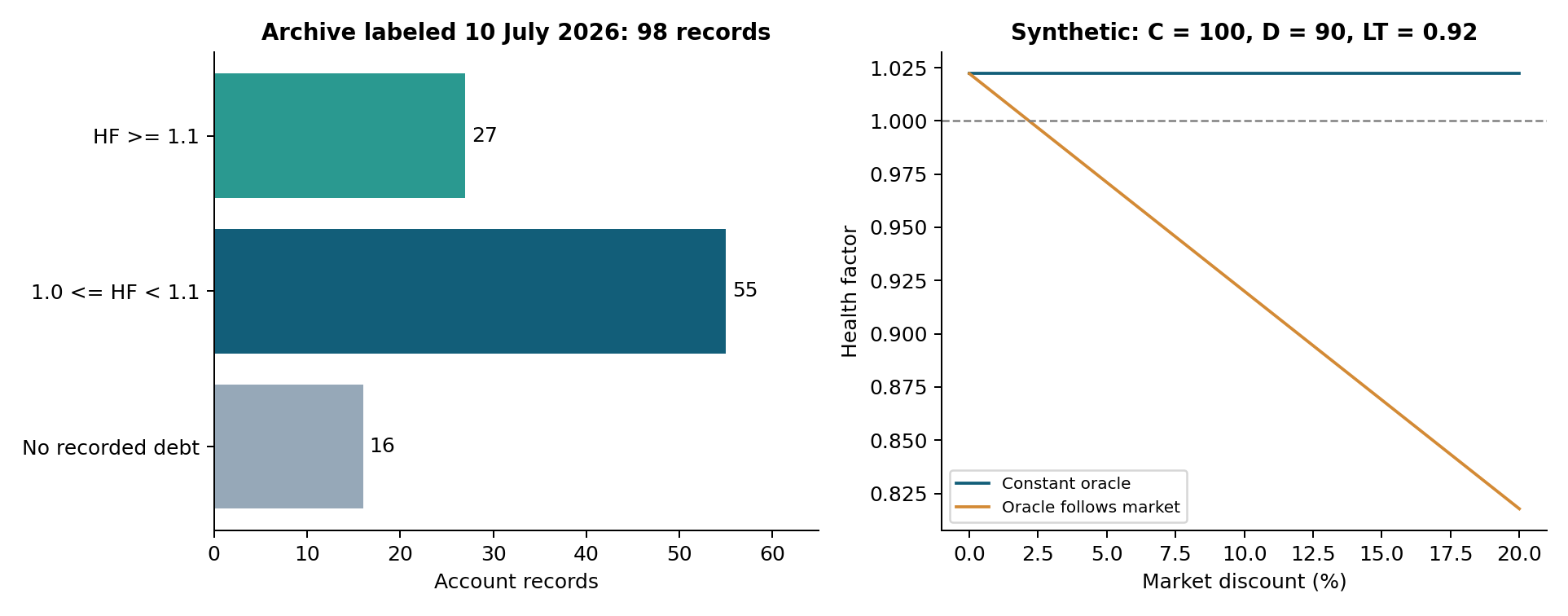
The model establishes two conditional results. A collateral-market discount can reduce economic equity without directly changing a protocol trigger when the oracle function is insensitive to that discount. Conversely, an oracle response can make an account eligible while a positive market-equity buffer remains. Neither result measures the probability of default.
The debt side can alter both conclusions. If collateral and debt valuations share the same multiplicative price input, that component can cancel in their ratio. Such cancellation depends on the entire relevant balance sheet and valuation function. A mixed debt portfolio, an exchange-rate change, or a different collateral asset can restore sensitivity. It cannot be inferred from the token symbol alone.
6. Eligibility does not ensure an executable liquidation
Suppose a liquidator repays one unit of debt measured in a stable numeraire and receives collateral with oracle value 1 + β, where β is the liquidation bonus available to that operation. Let r be the ratio of the collateral's executable market value to its oracle value, with debt acquired at the assumed numeraire price.
Ignoring fees and financing, the simplified gross margin per unit of repaid debt is:
Gross margin = (1 + β)r − 1
Break-even r = 1 / (1 + β)
With a 1% bonus, the break-even market discount is approximately 0.9901%; with a 5% bonus, it is approximately 4.7619%. These numbers come from the constructed equation and are not claims about the bonus applicable to the archived accounts. Gas, swap fees, protocol fees, slippage, financing costs, and failed execution lower the tolerable discount further.
The analysis also assumes receipt and sale of the underlying collateral. Aave's liquidation interface allows a liquidator to request collateral aTokens, so underlying liquidity and the marketability of the received claim can affect the economic path. The exact available operation must be checked against the deployed version and state. Aave, Pool contract documentation.
A health-factor monitor therefore needs a separate execution model. The monitor can correctly detect eligibility while overstating recoverable value if it prices a large sale at a small-trade quote. A redemption route can improve expected recovery while introducing delay, eligibility constraints, and financing needs. These are additional state variables, not interchangeable price corrections.
7. Oracle semantics and historical configuration
An oracle value needs an interpretation alongside its timestamp. A direct market-price estimate, a share exchange rate, a capped price, and a fixed reference each respond to different information. A stable value can represent an intentional valuation rule rather than a failed update.
Aave documents both ordinary price feeds and correlated-asset adapters. Its open stable-cap adapter implementation, for example, reads an underlying answer and applies an upper cap; this is different from maintaining an unconditional fixed price. Current source code clarifies the possible mechanism, but does not establish which version and parameters produced a historical observation. Aave, Oracle; Aave DAO, PriceCapAdapterStable.
Timestamp monitoring is still necessary. Chainlink describes heartbeat and deviation-triggered updates and exposes update timestamps for consumers. A fresh underlying answer can nevertheless be economically insensitive to a different asset's discount if the protocol deliberately references that underlying. Freshness and economic relevance are separate tests. Chainlink, Data Feeds Overview.
For a historical study, preserve the reserve's oracle source, the adapter's dependencies, the parameters effective at each block, and the account configuration that selects the relevant thresholds. Replaying prices through a modern implementation can create a counterfactual result while presenting it as historical fact.
8. Interpretation, limitations, and data requirements
The main empirical finding is a concentration of sampled borrowing accounts near the protocol's recorded eligibility boundary. It supports closer examination of valuation dependencies. It does not establish how many accounts would become eligible under a specific USDe discount, because the account sample is selected, component valuations are incomplete, and calls are asynchronous.
The reserve price ratio is a useful diagnostic, not a substitute for contract inspection. A full stress calculation would require eligible collateral quantities, all debt assets, matched historical prices, effective parameters, and an execution-cost model. The archive's account totals cannot be treated as an identified USDe-only balance sheet.
Three outcome labels should remain distinct in any derived dataset: eligible debt, meaning debt associated with accounts meeting a protocol condition; modeled recovery shortfall, meaning an amount produced by an explicit valuation scenario; and recorded reserve deficit, meaning a quantity established through protocol accounting. Relabeling the first or second as the third would overstate what was observed.
The article's synthetic experiment is useful because its assumptions are fully visible. It demonstrates the mechanism by which valuation rules can separate market equity from eligibility. Applying the mechanism to a live or historical market remains an empirical task requiring additional observations.
Data availability and reproducibility
This web article presents account-count aggregates, reserve valuation aggregates, the synthetic sensitivity experiment, and the figure. The private verification process retains source-file hashes, selection logic, arithmetic checks, and the figure-generation procedure. Source account rows are not part of the publication.
The empirical counts and reserve arithmetic were recomputed from the archived files for this article. No new account scan, transaction submission, or synchronized historical oracle replay was performed. Readers can reproduce the published sensitivity experiment from its explicit equations and distinguish it from the observed aggregate results.