USDe Backing, Custody, and Redemption: Three Different Balance-Sheet Questions
An archival reconciliation of reported assets and observable redemption inventory
Data vintage 20 September 2026 UTC collection; issuer status timestamp 14:57:41 UTC; sequential onchain observations
Abstract
Evaluating a synthetic dollar requires separate measurements of asset value, asset control, and the ability to deliver redemption assets. This article reconstructs those measurements from a retained USDe collection dated 20 September 2026. The issuer-status response reports USD 4.876 billion of backing against USD 4.872 billion of token supply, with a separately reported reserve fund of USD 62.087 million. A second response classifies USD 4.823 billion of assets, leaving a USD 52.907 million difference from the status total that cannot be reconciled from the archive. The difference is an unresolved reporting-perimeter or timing issue, not evidence of missing reserves. Onchain observations identify approximately 92.928 million stablecoin face units in the minting contract, equivalent to 1.91% of the observed token supply, alongside a configured redemption ceiling of 10 million USDe per block. Conditional scenarios show why a per-block ceiling, existing inventory, and replenishment must be modeled separately. The findings support a layered monitoring framework without treating an API coverage ratio as an audit or a static contract balance as total protocol liquidity.
Keywords: USDe; Ethena; reserve accounting; custody; redemption liquidity; synthetic dollars; reconciliation.
1. Research question and analytical perimeter
What can public protocol data establish about USDe's backing and redemption capacity, and what remains unresolved after the available numbers have been reconciled?
Three questions are often compressed into a single “backed” label. The first is whether assets have sufficient value relative to outstanding claims. The second is whether the relevant operator can control and realize those assets. The third is whether the operator can deliver the requested asset within a specified interval. Solvency, control, and liquidity interact, but they require different evidence.
A token can have assets with substantial long-run value while facing settlement delays. A contract can hold immediately transferable tokens while the broader portfolio has losses. A reported collateral ratio can look adequate while resting on stale valuations. These possibilities explain why a reserve study should begin with an accounting perimeter rather than a single percentage.
The present article analyzes one retained collection. It does not estimate USDe's current portfolio, assign a default probability, or extrapolate a long-term strategy transition from conflicting archived summaries. Every empirical number below is tied to that collection or to an explicitly hypothetical calculation.
2. Data sources and evidence hierarchy
2.1 The retained collection
The collection record is dated 20 September 2026 at 15:43 UTC. It combines contract reads with public issuer API responses. The issuer-status response has its own timestamp, 14:57:41 UTC, approximately 46 minutes before the collection record. The category-breakdown response retained by the collector has amounts and percentages but no independent observation timestamp.
The onchain supply and inventory fields were obtained through sequential contract calls. A block number is recorded for the run, but inspection of the collector shows that the relevant calls used the latest-state tag rather than pinning every call to that block. They should therefore be interpreted as nearby observations, not a simultaneous balance sheet at an exact block.
| Input | Evidence retained | Permitted use |
|---|---|---|
| Issuer collateralization status | Timestamped backing, token-supply, and reserve-fund totals | Recompute reported coverage and surplus |
| Issuer category breakdown | Five category amounts and percentages | Describe that response's composition |
| Contract reads | Supply, savings assets, stablecoin balances, configured limits | Describe observable onchain state during collection |
| Technical documentation | Minting, custody, and staking mechanisms | Explain mechanisms; preserve historical parameter values separately |
The historical API observations are attributed to Ethena's collateralization-status endpoint and collateral-breakdown endpoint. Those URLs identify the source services, not immutable copies of the September observations. The article's figures are recomputed from the retained responses rather than from whatever those services display today.
2.2 What is independently verified
The reanalysis checks addition, denominator selection, unit conversion, and agreement between the retained amounts and displayed results. It also inspects the collector to identify asynchronous reads and to distinguish token units from dollar-valued API fields. This establishes reproducibility of the derived arithmetic.
It does not independently audit offchain holdings, inspect custody contracts, verify exchange positions, or obtain legal confirmation of asset ownership. A response from an issuer is evidence of what the issuer reported. A contract balance is evidence of tokens held at a location. Neither alone proves the full asset-and-liability perimeter of a synthetic-dollar system.
3. Backing and reserve-fund arithmetic
Let B be the status endpoint's reported backing value, S its reported token-supply value, and R its separately reported reserve fund. The primary arithmetic is:
Reported backing coverage       = B / S
Reported backing excess         = B − S
Reserve-inclusive coverage      = (B + R) / S
Reserve-inclusive excess        = B + R − S
The last two expressions are conditional on the reserve being additional to B, rather than already included, and available for the modeled support purpose. The archive exposes separate fields; it does not supply a complete audited consolidation explaining every overlap or restriction. The article therefore labels these as reserve-inclusive arithmetic, not guaranteed recoverable capital.
| Measure | Archived value, USD millions |
|---|---|
Reported backing B |
4,875.903 |
Reported token supply S |
4,872.405 |
Backing excess B − S |
3.498 |
Separately reported reserve fund R |
62.087 |
| Reserve-inclusive excess, conditional | 65.584 |
Table 1. Recomputed from the issuer-status response timestamped 20 September 2026, 14:57:41 UTC.
The backing coverage is 100.0718%. The reserve fund equals 1.2743% of the same reported supply. Adding it once produces conditional reserve-inclusive coverage of 101.3460%. Reporting the latter without stating the treatment of the reserve would obscure the accounting assumption.
A USD 62 million fund is a stock, not an annual yield and not a promise that every loss will automatically be reimbursed. The relevance of its size depends on the event being modeled. Recurring negative carry consumes resources through time; an asset impairment changes portfolio value; a delay in asset delivery affects liquidity. Comparing all three to the same stock without a time or recovery assumption produces misleading conclusions.
4. The category response does not fully reconcile
The category-breakdown response yields:
| Reported category | Value, USD millions | Share of category sum |
|---|---|---|
| DeFi Lending | 1,543.374 | 32.00% |
| Liquid Stables | 1,362.709 | 28.25% |
| Crypto Basis | 785.929 | 16.30% |
| Institutional Lending | 572.677 | 11.87% |
| RWA | 558.306 | 11.58% |
| Sum | 4,822.996 | 100.00% |
Table 2. Categories are the issuer response's labels. The denominator is their own sum. “Liquid Stables” is not independently verified as an executable withdrawal classification.
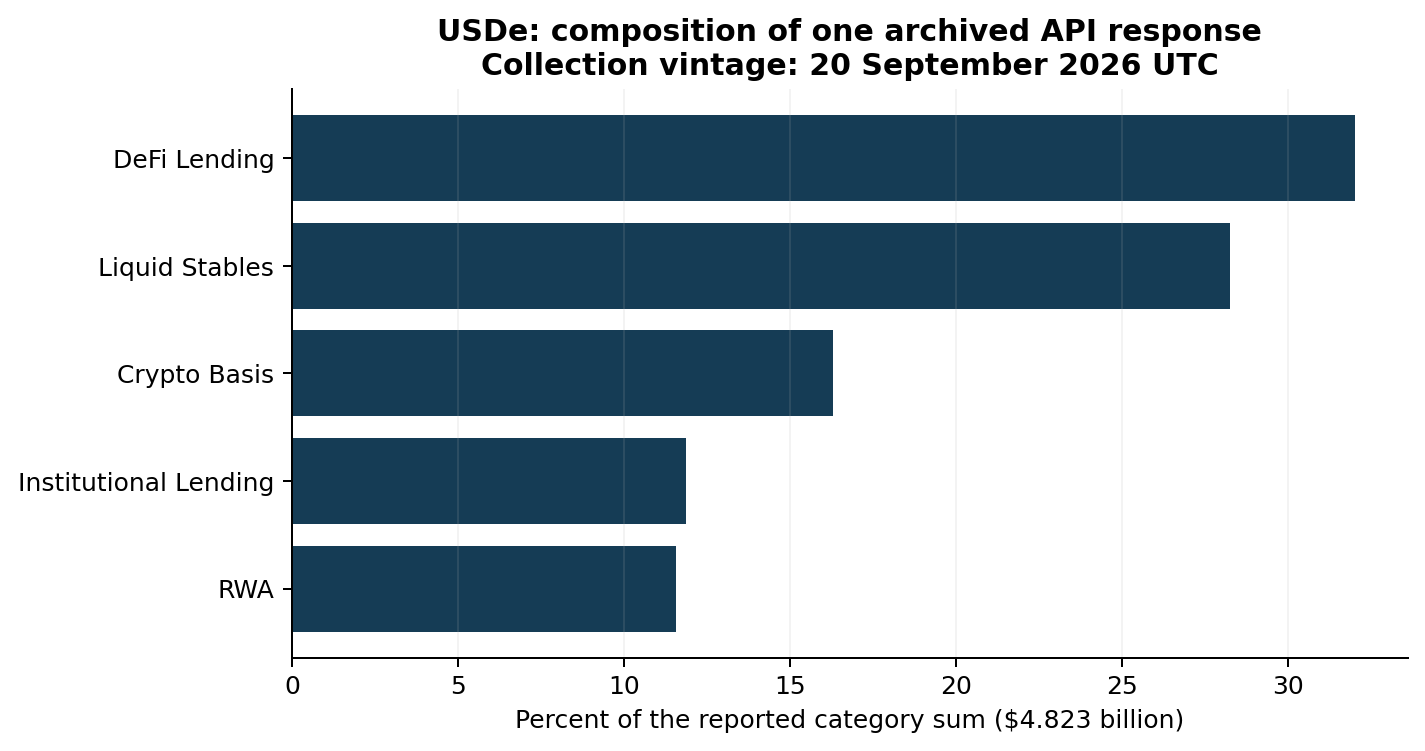
The status backing total exceeds the category sum by USD 52.907 million, or 1.0851% of the status backing total. The saved data do not establish why. Different refresh times, included assets, valuation conventions, or response versions could contribute, but those explanations remain hypotheses.
This is not an observed reserve shortfall. The comparison is between two asset-side summaries, not between independently verified assets and liabilities. It also does not justify silently scaling the five categories until they equal the larger total. Such scaling would allocate an unresolved difference according to an assumption rather than an observation.
The distinction materially changes the research conclusion. The collection supports the statement that DeFi Lending is 32.00% of the classified response. It does not establish that this is precisely 32.00% of the status endpoint's backing value at 14:57:41. Nor does it support a claim that nearly all backing had already moved into one strategy. Earlier narrative summaries with different composition figures cannot be used as a time series without reconciling their timestamps and classification versions.
5. Custody, investment exposure, and settlement are different dimensions
Custody describes who holds or controls an asset. Investment exposure describes what produces its return and potential loss. Settlement describes how value becomes available for delivery. These dimensions can overlap without being interchangeable.
Ethena describes off-exchange settlement arrangements that allow collateral to support centralized-exchange hedges while assets remain with custody providers. Its documentation discusses frequent settlement of derivative profit and loss and acknowledges that omnibus custody can limit public address-level visibility. Those are descriptions of the intended arrangement, not an independent conclusion about recovery in every possible insolvency. Ethena, Backing Custody Overview.
An asset held through a custody arrangement may still depend economically on an exchange hedge. An onchain lending receipt may depend on borrower collateral, liquidation mechanisms, oracle behavior, and pool liquidity. A fund share can add a separate subscription or redemption process. These dependencies need distinct fields in a reserve dataset.
The archive does not contain a complete reconciled cross-tabulation of custodian, investment venue, underlying asset, and redemption horizon. As a result, the five-category table cannot establish custody concentration, exchange-specific hedge exposure, or the cash available within a given number of hours.
A defensible look-through table would identify a position once, then attach multiple attributes to it. Summing a custody table with an investment table would often count the same asset twice. The correct operation is a join using a verified position identity, followed by a check against an independently defined accounting total.
6. Observable inventory and configured redemption limits
6.1 Stablecoin inventory in the minting contract
The contract-balance observations contain approximately:
| Asset | Face units, millions |
|---|---|
| USDT | 31.024 |
| USDC | 30.911 |
| USDtb | 30.990 |
| PYUSD | 0.004 |
| DAI | 0.000 |
| Total face units | 92.928 |
Table 3. Nearby sequential contract reads. The total assumes par when compared with USDe face value; it is not a market-marked USD valuation.
The inventory corresponds to 1.9072% of the onchain USDe supply observed in the collection, approximately 4.872435 billion tokens. The onchain supply differs slightly from the earlier API supply, by approximately 29,796 units. Given the asynchronous observations and potentially different valuation conventions, this small difference is retained rather than forcibly eliminated.
The contract inventory is an observable starting stock. It is not the protocol's total liquid assets and does not establish how much can be replenished from custody or other positions. Conversely, a large balance does not prove unrestricted access for every market participant. Assets, permissions, and operational execution must all align.
6.2 Limits constrain rate, not total backing
The retained settings show a global maximum of 200 million USDe minted per block and 10 million USDe redeemed per block. The ratio is 20 to one. The redemption setting is a ceiling, not measured throughput and not a daily redemption budget.
The project's public contract material describes role-restricted execution, benefactor permissions, per-block limits, and gatekeeping. Historical numeric settings in this study come from the archived calls rather than from example values in documentation. Ethena Labs, Public Contract and Protocol Materials.
It would be incorrect to multiply the per-block limit by a day's expected blocks and call the result available liquidity. That multiplication assumes continuous requests, transaction inclusion, authorization, asset availability, and replenishment. It describes a theoretical rate envelope under those assumptions. It cannot replace a liquidity balance sheet.
7. Conditional redemption scenarios
Let I denote the observed stablecoin face inventory, K the redemption ceiling per block, and D a hypothetical demand for USDe redemption at par. Under a deliberately simplified model:
Minimum blocks permitted by the ceiling = ceil(D / K)
Additional inventory required           = max(0, D − I)
The first expression is an optimistic lower bound on execution blocks. The second assumes that every counted inventory asset is acceptable at par and can be used for the requested redemptions. Neither expression models settlement delays or adverse prices.
| Hypothetical demand | USDe demand, millions | Minimum blocks at the ceiling | Additional face inventory required, millions |
|---|---|---|---|
| 1% of observed supply | 48.724 | 5 | 0.000 |
| 5% of observed supply | 243.622 | 25 | 150.694 |
| 10% of observed supply | 487.244 | 49 | 394.315 |
Table 4. Constructed scenarios, not observed redemptions or forecasts. Existing inventory is held fixed at 92.928 million face units.
For the 1% scenario, the counted inventory is numerically sufficient under the assumptions, while the block ceiling still requires at least five blocks. For the 5% and 10% scenarios, replenishment becomes necessary. The source data do not measure the time or haircut associated with replenishment, so no completion time is reported.
A more realistic liquidity model would use a cumulative delivery function L(h): the amount of the requested asset obtainable by horizon h, after fees, conversion haircuts, and operational constraints. Feasibility then requires both sufficient cumulative delivery and sufficient permitted execution capacity by that horizon. A balance snapshot identifies only a component of the initial condition for that model.
8. sUSDe adds a conversion stage
The same collection reports approximately 1.066 billion sUSDe shares representing 1.332 billion USDe of assets. These are different units. Adding the share count directly to USDe supply would create a unit error; adding the underlying assets as an independent reserve would duplicate a claim on already issued USDe.
The observed cooldown setting is 86,400 seconds, or 24 hours. That is an archived setting. The published staking contract material describes separate cooldown initiation and later withdrawal of underlying USDe when the cooldown is active. It does not make that underlying withdrawal equivalent to delivery of external stablecoins. Ethena Labs, StakedUSDeV2 Contract.
A holder exiting through the protocol can therefore face successive stages: convert the savings claim into available USDe, then obtain the desired external asset through an eligible redemption route or market trade. Secondary-market sale can provide another path, but its capacity and price require separate observations.
Ethena's documentation states that minting and redemption access is available to whitelisted users through its interface or API. The existence of that route supports the peg mechanism without establishing identical execution access for all holders. Ethena, How to Buy USDe; Ethena, API Overview.
9. A balance-sheet sensitivity without a default forecast
One useful arithmetic exercise asks how large a uniform write-down of B would equal the reserve-inclusive excess, assuming the separately reported reserve is fully available and unchanged:
Uniform backing write-down = (B + R − S) / B = 1.3451%
This number is a break-even sensitivity under specified assumptions. It is not a probability, a predicted loss, an automatic liquidation trigger, or an estimate of the market price after a shock. It also assumes no income, no asset recovery, no change in liabilities, and no overlapping reserve treatment.
Uniform impairment is rarely an adequate model of a complex portfolio. A custody interruption may initially delay settlement without reducing recoverable value. A credit impairment can cause a permanent loss concentrated in one position. Basis income can change over time while the underlying collateral remains present. The same headline amount can have different liquidity and solvency consequences.
The unresolved USD 52.907 million difference between the two asset summaries is of comparable order to the USD 62.087 million reserve fund. That comparison makes reconciliation operationally important. It does not permit the difference to be deducted as a loss or to be added as undisclosed capital.
10. Monitoring design and research conclusions
A monitoring system should preserve three linked records. First, a valuation record should retain the reported asset perimeter, supply denominator, reserve treatment, and update time. Second, a control record should identify permissions and the relevant custody or investment arrangement. Third, a delivery record should measure inventory, requested redemption assets, execution limits, pending withdrawals, and replenishment over explicit horizons.
These records should reconcile before producing a composite coverage metric. Unknown fields should remain unknown. A failed balance read must not become a measured zero; a category omitted from a response must not become a confirmed missing asset; a per-block limit must not become achieved throughput.
The archive supports four findings. Reported backing coverage was slightly above par in its timestamped status response. The category breakdown did not match that total and lacks the information needed to resolve the difference. A modest fraction of observed supply was present as stablecoin inventory in the minting contract. Redemption capacity consequently depended on both configured rate limits and replenishment, with access conditions providing an additional constraint.
This layered interpretation produces a more useful research result than either an unqualified assurance of backing or an unsupported insolvency claim. It identifies which questions the retained evidence answers and which additional measurements would materially improve the analysis.
Data availability and references
This web article presents only rounded protocol-level aggregates, explicitly labeled scenarios, and the figure. Wallet identifiers, contract addresses, individual transactions, private infrastructure, and source responses are excluded. The offline reproduction checks arithmetic and input provenance; it does not constitute an independent reserve audit.
Primary sources are linked next to their associated mechanisms and reporting interfaces. Technical materials were checked on 5 October 2026, while all historical parameter values and balances are taken from the September archive. No current API value has been substituted into the historical tables.