One Ticker, Several Claims: USDC and USDT Across Chains
Issuance, redemption, and the measurement of cross-chain stablecoin activity
Data vintage Archived CCTP query for 26 September–2 October 2026 UTC; separate sampled Ethereum logs from 30 September–1 October 2026 UTC
Abstract
A stablecoin ticker does not uniquely identify the instrument held by an investor. Native issuance, bridge representations, exchange liabilities, and lending receipts can all refer economically to the same dollar unit while providing different paths to settlement. This article develops a claims-based framework for USDC and USDT and tests two measurement consequences using archived cross-chain data. Reaggregation of a retained nine-chain CCTP query produces 98,267 source burn events representing 2.526 billion USDC face units. Ethereum contributes 45.4% of the amount but 15.4% of events, demonstrating that transaction activity and transferred principal answer different questions. A separate audit decodes 380 unique Ethereum CCTP V2 source messages; every source nonce is zero. Consequently, a source-nonce join cannot identify their corresponding destination messages. The empirical contribution is a reproducible accounting and data-validation case study, with explicit separation between issuer supply, token representations, bridge throughput, and completed settlement. The study does not estimate reserve adequacy or compare default probabilities between issuers.
Keywords: stablecoins; USDC; USDT; CCTP; bridge accounting; issuance; redemption; token identity.
1. The research problem
Suppose a database reports that a chain has gained one billion units of a dollar stablecoin. Several economic events could produce that observation. An issuer might have accepted new dollar funding. An existing holder might have moved tokens from another chain. A bridge might have issued a representation against tokens locked elsewhere. A token contract might have created inventory that has not entered circulation. Each event changes an onchain balance; their implications for global dollar demand differ.
The research question is therefore: what information is required to interpret stablecoin balances and cross-chain activity as claims on underlying assets? This is directly relevant to reserve research, exchange-flow analysis, and market-size estimates. A classification error at the instrument level can propagate through otherwise correct arithmetic.
USDC and USDT are useful examples because issuer operations coexist with multiple transfer mechanisms. Their extensive use does not remove the need to identify the exact instrument, chain, and settlement route. The analysis below treats a token as a claim with an operational path, then asks which quantities can be measured from retained data.
2. The unit of analysis is a claim
2.1 Four separate questions
A stablecoin observation should answer four questions: what token is present, which organization or mechanism supports its value, which intermediate claims are involved, and how the holder can reach the desired settlement asset.
These questions create four distinct layers:
| Layer | Example observation | Economic meaning |
|---|---|---|
| Issuer | A reserve-backed token issued through an issuer's system | A claim governed by the issuer's arrangements and eligibility rules |
| Representation | A destination token backed by an escrowed source token | An additional conversion path to the underlying token |
| Venue | An exchange balance or lending receipt denominated in USDC | A claim on an intermediary or pool, with its own withdrawal conditions |
| Settlement | Successful delivery of native tokens or bank money | The completion of a specified conversion path |
These layers are analytical categories rather than a hierarchy of investment quality. A well-operated additional layer can provide valuable services; a direct token can still have issuer, operational, and market risks. The point is to measure the dependency introduced by each layer.
A database should identify a deployment internally by chain and contract or native asset identifier, with a time-dependent classification. The ticker is a display label. Publishing individual identifiers is unnecessary for the aggregate findings reported here.
2.2 Native USDC and bridged USDC
Circle distinguishes native USDC from bridged representations and states that Circle Mint supports native USDC on the listed networks. Its support documentation gives examples of bridged forms that cannot be deposited directly through the same route. Circle Mint access itself is a business service subject to eligibility. Thus native status identifies an issuance relationship; it does not establish that every token holder has an operational bank-redemption account. Circle, USDC Supported Blockchains; Circle, USDC.
Consider a holder who receives a bridged representation and wants bank dollars. The economically relevant chain can include representation redemption, delivery of native USDC, access to an eligible intermediary or issuer account, and fiat settlement. A price difference can therefore compensate for costs or delays at several points. Calling both assets “USDC” hides that path.
3. Cross-chain transfer mechanisms and supply accounting
3.1 Burn and mint
Circle's CCTP moves native tokens using source-chain burns, an attestation process, and destination-chain minting. The movement reallocates tokens between networks. It should be distinguished from an issuer accepting new fiat funding. Circle, CCTP.
For an idealized completed transfer of face amount q, ignoring fees and unrelated issuance:
Source-chain change       = −q
Destination-chain change  = +q
Global token-unit change  = 0
Gross cross-chain amount  = q
This identity is an accounting illustration, not a claim that all observed transactions completed without fees. A source burn observed before destination settlement creates an in-flight state. Adding burns and corresponding mints as two economic transfers would count the same movement twice. Conversely, counting only destination mints as new issuer demand would confuse reallocation with creation.
3.2 Lock and mint
USDT0's documentation describes an architecture that locks the original asset in an Ethereum adapter, creates corresponding tokens on destination chains, and reverses the process through burning and unlocking. It also describes dedicated lockbox routes. The precise route and deployment matter to the dependency graph. USDT0, Technical Documentation.
In an idealized lock-and-mint transfer of 100 units, the source token continues to exist inside escrow while 100 destination representations become available. A raw sum of source-token supply and destination-representation supply increases by 100. The external dollar claim has not thereby doubled. A consolidated count needs to eliminate the escrow/representation duplication while preserving a separate measure of destination liquidity.
The same reasoning applies to multiple wrappers. Counting a lending receipt, its underlying bridged token, and the original token as three independent dollar reserves is an accounting error. All three may be useful records in a claims graph; they are not three independent units of backing.
3.3 Issuer inventory and chain swaps
Tether's issuance primer distinguishes authorized inventory, issued tokens, redeemed inventory, and destroyed tokens. A mint into issuer inventory and release into circulation are therefore different observations. Its chain-swap explanation also describes reallocating USDT between networks, including cases where source tokens remain in treasury rather than being immediately burned. Tether, Issuance Primer; Tether, Explained: Chain Swaps.
A cross-chain supply study must consequently specify both its perimeter and its treatment of inventory. A change in contract-level totalSupply alone cannot establish new customer funding. Neither can a bridge-volume series establish global net issuance. These are distinct stocks and flows that can be reported together after their definitions are fixed.
4. Data and empirical method
4.1 Retained aggregate query
The first input is a retained query response containing 16 chain/version cells. The accompanying collection record identifies the requested interval as 26 September through 2 October 2026 UTC. The saved response records query completion on 3 October 2026 and contains counts and normalized burn amounts for nine source chains.
The source SQL and the underlying weekly transaction rows are not retained alongside that response. Accordingly, this article independently verifies the arithmetic of the 16 cells, but cannot independently verify the query's original contract filters, deduplication, or date predicates. The results are described as the retained query result, not as a complete reindexed census of CCTP. The query's amount field is interpreted as USDC face units from the collection record, without applying a market-price series.
For source chain c, the reaggregation is:
N_c = sum of reported burn-event counts over versions
A_c = sum of reported USDC face amounts over versions
count share_c = N_c / sum(N_c)
amount share_c = A_c / sum(A_c)
No destination-chain inference is made from these source totals. No wallet clustering or account attribution is required.
4.2 Independent source-message sample
The second input contains raw Ethereum logs gathered in a separate collection. The collector requested the first page, capped at 1,000 logs per contract, over a selected block range. This is a convenience sample whose coverage is bounded by pagination; it is not a random or complete sample of the week.
Within the retained MessageTransmitter V2 records, 380 MessageSent events are identified. Duplicate checking uses the block, transaction, and log identity internally. Their event timestamps span 30 September 2026 at 19:21:23 UTC through 1 October at 00:38:35 UTC. Raw identifiers remain outside the publication.
The analysis decodes the ABI-encoded message bytes, checks the version and source-domain fields, and extracts the 32-byte source nonce at byte offset 12. The deployment mapping is checked against Circle's contract documentation. Circle, CCTP Contract Addresses.
5. Results: counts and amounts describe different activity
The retained aggregate query sums to 98,267 burn events and 2.526 billion USDC face units. Its distribution is:
| Source chain | Burn events | Face amount, million USDC | Share of amount |
|---|---|---|---|
| Ethereum | 15,112 | 1,146.895 | 45.4% |
| Arbitrum | 39,777 | 705.228 | 27.9% |
| Base | 23,866 | 322.007 | 12.7% |
| Polygon | 7,042 | 145.540 | 5.8% |
| Avalanche | 4,342 | 96.795 | 3.8% |
| Sonic | 1,155 | 84.396 | 3.3% |
| OP Mainnet | 6,182 | 19.837 | 0.8% |
| Unichain | 632 | 3.879 | 0.2% |
| Linea | 159 | 1.057 | less than 0.1% |
Table 1. Original reaggregation of retained chain/version cells. Amounts are face units; rounding can prevent displayed rows from summing exactly.
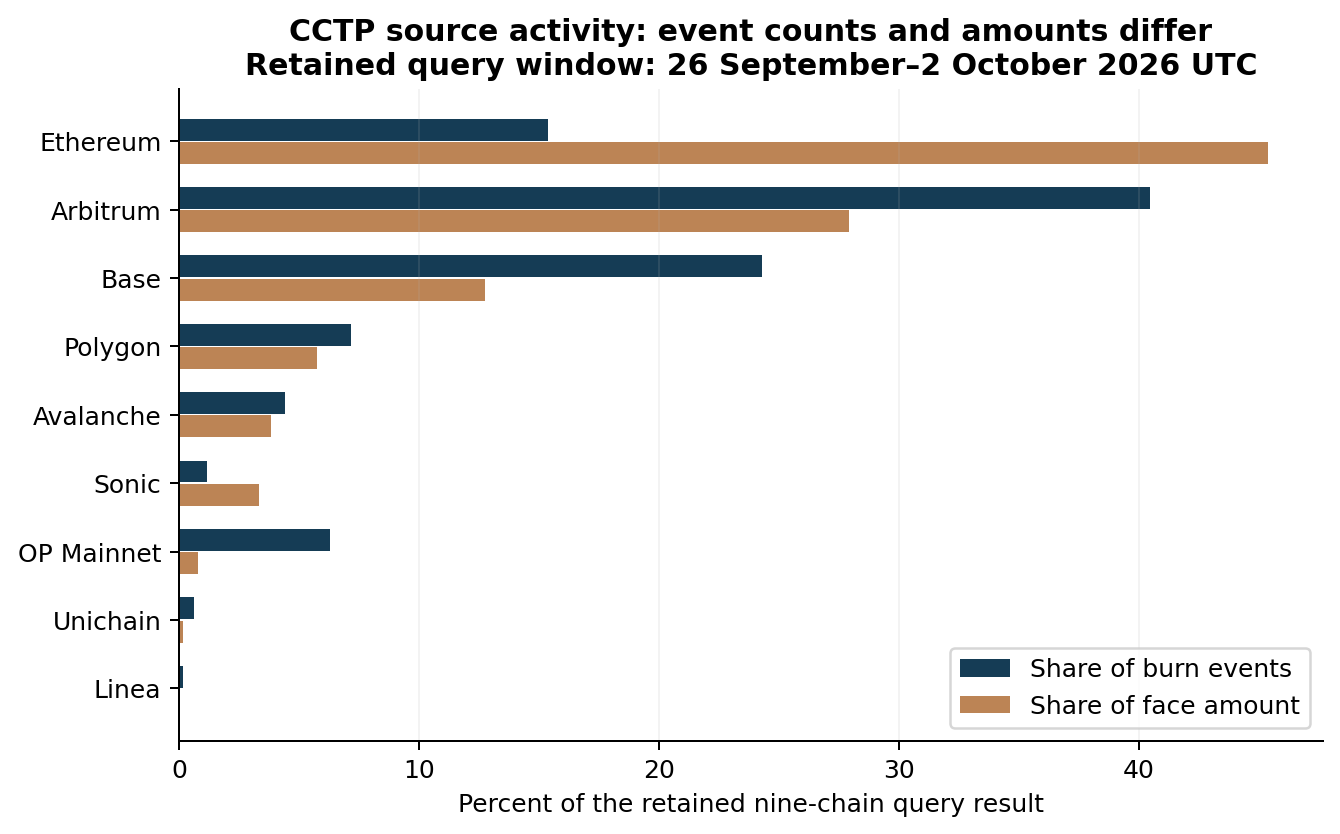
Ethereum accounts for only 15.4% of events despite providing 45.4% of face amount. Arbitrum contributes 40.5% of events and 27.9% of amount. The average amount per event is approximately 75,893 USDC for Ethereum and 17,730 USDC for Arbitrum in these cells. These averages cannot identify a typical user's behavior; a small number of large transfers can materially affect the mean.
Version differences are also material. V2 supplies 93,630 events, or 95.3% of the count, but 79.3% of the face amount. V1 supplies 4,637 events and 521.863 million USDC. Version adoption measured by count thus produces a different numerical answer from adoption measured by amount. Version aggregates.
None of these figures is global net issuance. Nor does the 2.526 billion figure establish completed settlement during the same interval. It measures the retained source-side amount. A complete settlement study would match destination observations and allow for transactions that cross the window boundary.
6. A reproducible matching failure: the source nonce
All 380 unique source messages contain a zero nonce. The decoding checks also find the expected message version and Ethereum source-domain value throughout the selected sample. Aggregate audit counts.
A join on the source nonce would collapse 380 distinct events into one key. Even adding the source chain would leave the ambiguity intact, because every sampled event originated on Ethereum. This provides a direct empirical example of why a field named nonce cannot be assumed to function as a universal transaction identifier.
Circle's technical guide states that V2 nonces are assigned offchain and retrieved through its message endpoint using the source transaction. The documented message layout places the nonce at the offset used by this audit. Circle, CCTP Technical Guide.
The practical implication is a two-stage data model. First, preserve the unique source event. Second, attach the attested message and destination execution when independently observed. A record can then distinguish source-seen, attested, and destination-completed states. Matching by recipient and amount alone is weaker evidence because a recipient can receive repeated amounts and fees can change the credited quantity.
The zero-nonce result does not indicate a security failure in CCTP. It identifies a failure in a possible research implementation: treating a placeholder in a source event as the final cross-chain message identity. The sample also cannot estimate the probability of incomplete transfers, because destination execution was not reconstructed here.
7. Redemption is a path with eligibility, quantity, and time
A settlement path has at least three independent dimensions. Eligibility concerns who can invoke it. Quantity concerns the amount that can be processed. Time concerns how long the route takes to complete. A quoted one-dollar target does not remove these dimensions.
Tether's fee schedule, checked on 5 October 2026, lists a minimum acquisition or redemption amount of USD 100,000 and a redemption fee equal to the greater of USD 1,000 or 0.1%. Account approval is also required. These are current published terms, not historical parameters assigned to the archived CCTP observations. Tether, Fees.
For a holder below a direct-redemption threshold, selling on a market may be the available economic exit. The relevant price then includes market depth, spread, intermediary costs, and settlement timing. For a holder of a representation, the bridge conversion comes before that exit. For an exchange depositor, an exchange withdrawal can be another preceding step.
A useful comparative matrix records these steps without reducing them to an unsupported single risk score:
| Instrument held | Immediate exit being evaluated | Additional dependency to record |
|---|---|---|
| Native USDC | Token transfer, market sale, or eligible issuer redemption | Issuer access and destination acceptance |
| Bridged USDC representation | Return through its bridge or sale into another asset | Escrow, message validation, and available liquidity |
| Native USDT | Token transfer, market sale, or eligible issuer redemption | Issuer inventory and redemption conditions |
| USDT0 | Transfer within its network or conversion to underlying USDT | Applicable adapter, verification, and unlock path |
| Lending receipt denominated in either token | Withdrawal of the underlying token | Pool liquidity and claim conversion |
This framework also explains why different chain markets can have different prices without implying different global reserve values. A route-specific operational interruption can affect the cost of delivery while leaving another route available. Establishing the cause requires route-level observations; price alone does not identify it.
8. Implications for a research-grade stablecoin dataset
The empirical exercises suggest a concrete separation of tables. An instrument registry stores chain, deployment, decimals, issuer relationship, representation mechanism, and classification dates. An event ledger records unique source observations, raw quantities, and event type. A settlement ledger records matched destination execution and the evidence used to associate the two sides. A supply ledger distinguishes issuer circulation, treasury inventory where identifiable, locked collateral, and outstanding representations.
A consumer should be able to ask three different questions without silently changing definitions: how much issuer-backed supply exists, how much usable stablecoin liquidity is present on a chain, and how much cross-chain activity occurred. A bridge representation can count toward local liquidity while being eliminated from a consolidated issuer-supply total. That is a deliberate accounting choice, not inconsistent data.
Versioning matters as much as classification. A bridge upgrade, issuer-supported migration, or change in redemption route can alter the meaning of a token observation. Retrospective normalization must retain the classification effective when the observation occurred, alongside the date the research system learned of the change.
9. Findings and limits
The archive demonstrates two concrete sources of analytical error. Event-count rankings and amount rankings differ substantially, and CCTP V2 source nonces in the audited sample cannot identify completed cross-chain transfers. Both problems can arise even when every numerical field is read correctly.
The nine-chain aggregate lacks the original SQL and full underlying records, limiting independent verification of coverage. The raw-message audit has a capped sampling design and a different observation window. The study has no complete USDT transfer census, no issuer bank records, and no destination settlement replay. Its USDT comparison is consequently structural, while its numerical exercise concerns CCTP.
The main contribution is an operational definition of what a stablecoin database must preserve: the instrument, the claim, the route, and the accounting perimeter. With those definitions in place, supply and flow statistics become interpretable, and a familiar ticker no longer substitutes for an explanation of the asset.
Data availability and references
This web article presents rounded chain-level aggregates, audit counts, and the figure. Individual addresses, transactions, account records, and private collection infrastructure are excluded. Reaggregation and message decoding were performed offline against retained inputs; the article had not been published externally when the original manuscript was prepared.
Primary references appear next to the claims they support. Protocol documentation was checked on 5 October 2026. The source-window label for the aggregate result comes from its retained collection record; the exact raw-message times come from decoded log metadata. These forms of provenance are deliberately distinguished.