Are Polymarket Whales Really Taking a Side? Gross Holdings, Complementary Claims, and Directional Exposure
A quantity-based audit of an archived large-account sample
Data vintage Saved position archive dated 6 May 2026 UTC; account observations were collected sequentially
Abstract
Large prediction-market holdings are often interpreted as strong directional conviction. That inference can fail when a portfolio contains both sides of the same binary condition, resolved claims awaiting redemption, or cash. This article audits an archived Polymarket sample containing 56 selected accounts and 28,036 saved position rows. Removing 495 identical duplicate rows leaves 27,541 distinct account-position records, of which 3,778 are classified as nonredeemable in the saved responses. A quantity-based decomposition identifies complementary claims without relying on average entry prices. Among 55 accounts with positive nonredeemable marked value, the median matched-complement share is 5.23%, while the equal-account mean is 32.79%. The wide difference illustrates the heterogeneity obscured by a single gross-holdings measure. Monetary totals and individual records are withheld because of concentration and privacy considerations. The analysis establishes an accounting correction for a selected archive; it does not identify trader intent, investment skill, beneficial ownership, or all portfolio hedges.
Keywords: Polymarket; prediction markets; conditional tokens; directional exposure; portfolio accounting; deduplication; data quality.
1. What does a large holding actually measure?
A large position value can describe committed capital without revealing how strongly a portfolio depends on a particular outcome. The distinction is especially important for binary prediction contracts, where complementary claims can offset within the same account.
Consider an account holding equal quantities of the two outcomes of one binary condition. Under ordinary complete-set mechanics, one outcome pays when the other does not. The pair has a fixed total terminal entitlement in collateral units, conditional on the contract's payout framework. A dashboard that adds the market values of both legs captures inventory value, but interpreting that sum as a directional bet overstates the outcome dependence.
Polymarket documents the creation of complementary outcome tokens and the operations for splitting collateral, merging complete sets, and redeeming resolved claims. These mechanics motivate a quantity-based decomposition. Their existence does not reveal why a specific account acquired the tokens. Polymarket, How Positions Work; Manage Positions.
The research question is therefore narrower than identifying informed traders: how much of observed marked inventory consists of matched complementary claims, and how much remains unmatched within the same binary condition?
This question can be answered from a carefully audited position snapshot. Inferring conviction requires additional evidence about orders, hedges, mandates, inventory management, and information available to the trader.
2. The archived sample
2.1 Selection and vintage
The source archive contains 56 accounts selected by an earlier large-account discovery process. Its selection logic combined position-value estimates and cash balances, using a threshold of approximately one million dollars in either component or their combination. Candidate discovery used market-holder and leaderboard-related sources rather than a random sample of all accounts.
The archive's saved modification date is 6 May 2026 UTC. That establishes the retained file's vintage, not a common observation time for every account. Account queries were performed sequentially, and the normalized archive does not preserve a source timestamp for each position response.
This sample can overrepresent visible, high-value, or frequently discovered accounts. Inclusion depends on what the preceding collectors could find and value. No population weights are available, and the analysis does not estimate the proportion of all Polymarket users following any particular strategy.
Accounts are also not people. One entity may use several accounts; a shared account can represent multiple economic interests. The analysis performs no identity resolution and publishes no account identifiers or pseudonyms.
2.2 Relevant fields
The saved records contain a condition identifier, outcome-token identifier, quantity, current price, current value, opposite-token identifier, outcome index, and a redeemable flag. These correspond to fields documented in the legacy positions interface. The API documentation is used to interpret the schema, not to certify completeness of the historical responses. Polymarket, Get Current Positions for a User.
Average entry price is available but is not used to determine whether quantities offset. Purchase history affects cost basis and profit; the present analysis concerns the payoff of currently held claims.
Cash balances are outside the position decomposition. Redeemable records are also separated before calculating the primary exposure statistics. The archive's Boolean flag is retained as reported: “nonredeemable” is the reproducible classification, while “live” is a convenient shorthand that cannot guarantee every market is currently accepting trades.
3. The first correction: duplicate positions
A portfolio snapshot should contain one row per account, condition, and outcome token. Repeating that row does not create a second economic claim.
The raw archive contains 28,036 rows. Within each account, the audit groups rows by the pair of condition identifier and token identifier. It finds 495 duplicate extras. Every duplicate matches the retained row across the complete saved record; no conflicting duplicate value was found.
The audit keeps one instance of each identical record. If duplicates had contained different values, simply summing them or retaining an arbitrary row would have been inappropriate without a timestamp policy. That conflict does not arise in this particular archive.
| Accounting stage | Row count |
|---|---|
| Raw saved position rows | 28,036 |
| Identical duplicate extras removed | 495 |
| Distinct account-position records | 27,541 |
| Records flagged redeemable | 23,763 |
| Records not flagged redeemable | 3,778 |
Table 1. Original archive audit. Counts reconcile exactly: 28,036 − 495 = 27,541, and 23,763 + 3,778 = 27,541.
Duplicate removal changes a data-quality fact, not a conclusion about misconduct or strategy. Pagination, repeated collection, or storage behavior can create duplication. The saved file is sufficient to identify identical records but does not identify the original cause.
This step precedes pairing because duplicated outcome rows could otherwise inflate the apparently matched inventory or produce false multi-leg conditions.
4. The second correction: match quantities rather than entry prices
4.1 Exact binary decomposition
For one account and one validated binary condition, let q_Y and q_N be the YES and NO quantities. Let p_Y and p_N be their stored current prices. Define the matched quantity:
a = min(q_Y, q_N)
The position contains a complete complementary sets and the residual quantities:
r_Y = q_Y − a
r_N = q_N − a
At least one residual is zero. Marked value decomposes as:
gross marked value = q_Y × p_Y + q_N × p_N
matched marked value = a × (p_Y + p_N)
residual marked value = r_Y × p_Y + r_N × p_N
This is an accounting identity. It does not require observed market prices to sum exactly to one. If quotations are stale or inconsistent, the complete set's market valuation can differ from its contractual collateral entitlement.
For the usual binary winner-takes-one payoff, the difference between the account's two terminal payouts is abs(q_Y − q_N) collateral units. That payoff range is another useful exposure measure, and it is different from residual marked value. A small-probability outcome can have a low current mark but a substantial possible payout.
4.2 Matching conditions
The implementation groups nonredeemable records by condition within an account. A pair qualifies only when there are exactly two distinct token rows, each identifies the other as its opposite token, and their outcome indices differ.
All 324 two-row account-condition groups in the deduplicated nonredeemable sample satisfy the reciprocal token check. The archive contains no nonredeemable group with more than two distinct tokens. Single-token groups remain unmatched within the observed account-condition boundary.
Stored quantities and current prices are nonnegative, and observed current prices lie between zero and one. As a numerical reconciliation, the two token quantities multiplied by their current prices agree with the sum of reported current values to within 0.001 collateral units for every matched group. Small residual discrepancies reflect stored rounding.
These checks verify internal consistency of the saved representation. They do not prove that the collector retrieved every position or that all balances were unchanged while it paginated.
4.3 Why an entry-price heuristic fails
The earlier analytical routine marked two legs as offsetting when their average entry prices both lay between 0.40 and 0.60. It then treated the full value of those qualifying legs as matched inventory.
There are two independent problems. First, two complementary claims purchased at different prices can still offset. Entry price does not determine the current payoff identity. Second, two legs purchased near 0.50 need not have equal quantities. Treating both entire legs as offsetting can hide the excess quantity on the larger side.
A constructed example makes the second problem concrete. If an account holds 150 YES and 100 NO, only 100 complete sets are matched. The remaining 50 YES claims still depend on the outcome, regardless of whether both recorded average entry prices happen to be 0.50.
The corrected calculation identifies matched holdings. It does not label them “minted inventory,” because a snapshot does not establish whether the account split collateral, bought both sides, received transfers, or used another acquisition route.
5. Constructed payoff examples
The following examples are intentionally synthetic. They use a YES price of 0.60 and a NO price of 0.40, with all values expressed in collateral units.
| Holdings | Gross marked value | Matched value | Residual marked value | Payout if YES | Payout if NO | Payout range |
|---|---|---|---|---|---|---|
| 100 YES, 0 NO | 60 | 0 | 60 | 100 | 0 | 100 |
| 100 YES, 100 NO | 100 | 100 | 0 | 100 | 100 | 0 |
| 150 YES, 100 NO | 130 | 100 | 30 | 150 | 100 | 50 |
Table 2. Constructed accounting examples, unrelated to any source account.
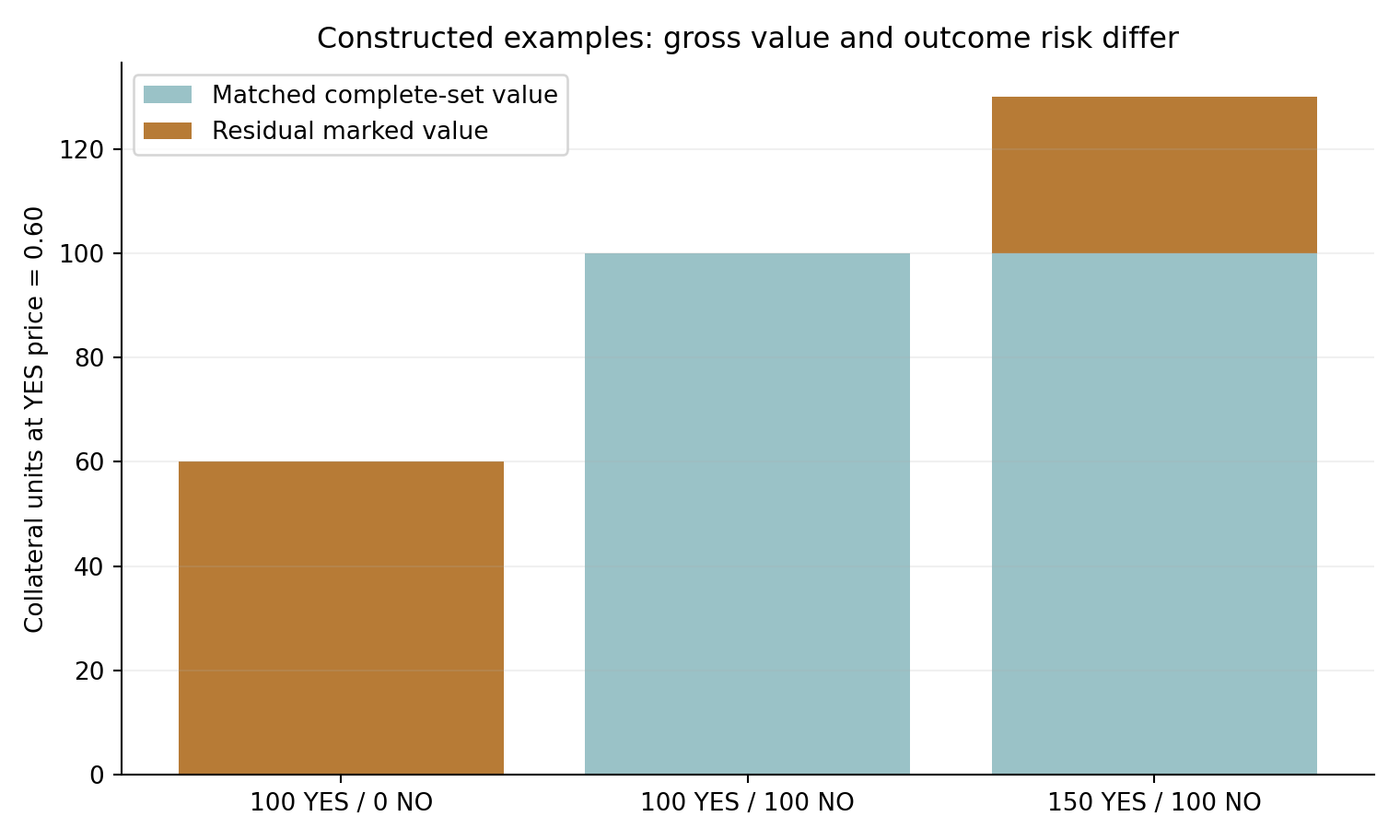
The middle example has greater gross marked value than the first while its two ordinary terminal outcomes pay the same amount. The third has a substantial gross value but only a residual YES position after matching complete sets.
Fixed outcome entitlement does not eliminate every risk. The collateral token can change value against fiat, merging can incur costs, and contract or operational failures can prevent timely realization. “Matched” describes the binary payoff structure; it is not a guarantee of frictionless cash equivalence.
6. Results at the account level
For account i, define G_i as its total nonredeemable marked value and M_i as the matched marked value calculated above. The main statistic is:
matched_share_i = M_i / G_i, for G_i > 0
Fifty-five of the 56 source accounts have positive value under this denominator. Thirty-six accounts contain at least one validated complementary pair. The public analysis summarizes the share distribution across the 55 eligible accounts, giving each account equal weight.
| Whole-cohort statistic | Matched-complement value share |
|---|---|
| 25th percentile | 0.00% |
| Median | 5.23% |
| 75th percentile | 72.48% |
| Equal-account mean | 32.79% |
Table 3. Original aggregation after identical-row deduplication. Percentiles use linear interpolation. These are account-share summaries, not a market-wide fraction of dollar holdings.
The contrast between the median and mean reflects a heterogeneous sample. Many accounts have little matched value, while a substantial portion of the share distribution contains much larger matched fractions. Reporting only the mean would obscure the low median; reporting only the median would obscure the upper part of the distribution.
A different estimator, sum(M_i) / sum(G_i), would weight accounts by marked value. That answers how much of the sampled inventory value is matched. It does not answer what the typical sampled account looks like. Because monetary totals in this archive are concentrated, the value-weighted result and underlying amounts are withheld. The equal-account estimates are published with their denominator clearly stated.
6.1 Comparing the two classification methods
Reapplying the historical average-price heuristic to the same deduplicated records yields an equal-account mean classified share of 30.44%. The corrected quantity method gives 32.79%, a difference of 2.35 percentage points. The mean absolute account-level difference is 2.43 percentage points.
The average disagreement is modest in this selected sample. That does not make the heuristic conceptually correct. Its errors depend on quantities and acquisition histories, so cancellation or a small sample-average difference cannot establish reliability for a different portfolio.
The comparison also isolates the pairing rule from the duplicate problem: both methods are evaluated after the same deduplication and redeemable filtering. Otherwise, a reported improvement could mix two unrelated corrections.
7. The remaining exposure is not necessarily a trader's belief
7.1 Portfolio scope matters
A single unmatched YES position can be offset by another condition with related economic exposure, a position on another venue, or an external business risk. These relationships are not identifiable from one account's token rows alone.
Conversely, two conditions with similar titles are not automatically interchangeable. Differences in deadlines, resolution sources, exclusions, and event definitions can leave substantial residual risk. A research pipeline should not merge positions based only on text similarity.
Negative-risk events introduce formal links across conditions. Polymarket's documentation describes conversion relationships between a NO token and YES tokens in other outcomes of the same linked event. The present study performs only the direct same-condition complementary match. It does not solve the larger event-level portfolio conversion problem. Polymarket, How Positions Work: Standard and Negative-Risk Markets.
Accordingly, the residual calculated here is exposure remaining after a specified local accounting operation. It is not a comprehensive estimate of an entity's net economic risk across all markets and accounts.
7.2 Holdings do not identify acquisition intent
Matched claims can arise from market making, inventory management, transferred assets, or deliberate complete-set ownership. A large unmatched position can arise from liquidity provision that has not yet been rebalanced. A snapshot cannot uniquely classify any of those motives.
Trade counts, rebates, and leaderboard activity can add context, but they require their own coverage and timing audit. A capped activity endpoint is not necessarily a lifetime history. Positive historical performance does not establish that the current residual position was selected because of private information.
These restrictions matter for products that label accounts as “smart money,” “market maker,” or “conviction trader.” Such labels should have explicit evidence and a confidence policy. The matched-share statistic is a measurable feature; it does not itself justify a behavioral identity.
8. Redeemable claims, cash, and completeness
The 23,763 redeemable records are excluded from the main nonredeemable denominator. That exclusion avoids interpreting a resolved entitlement awaiting redemption as a fresh directional forecast. However, the flag alone does not establish that cash has already been received.
Polymarket distinguishes merging complementary live holdings from redeeming claims after a result. Both change the form in which value is held, but they operate on different states. Historical analysis should preserve those states and the applicable collateral representation rather than substituting the current interface's terminology into older records. Polymarket, Manage Positions.
Completeness remains a separate concern. The original collector used paginated requests with a finite stopping rule and did not preserve a synchronization watermark. A response set can therefore omit positions or combine observations from different instants. Deduplication repairs confirmed repetition; it cannot recover missing rows.
If a complementary leg is missing, the observed pair share can be understated. If prices update between pages, current-value comparisons can be asynchronous. These are coverage limitations, not reasons to impute an unseen matching leg. The article leaves unobserved claims unobserved.
9. Reproducibility and release
This web article presents the whole-cohort account-share aggregates, synthetic payoff examples, and figure. It excludes account addresses, market titles, outcome-token identifiers, individual balances, trading histories, and concentrated monetary totals.
The calculation sequence is deterministic: deduplicate exact account-condition-token records; reject conflicting duplicates; separate redeemable rows; validate reciprocal complementary tokens; calculate the minimum matched quantity; reconcile marked values; and summarize account-level shares over accounts with a positive denominator. Internal working material retains the input checksum and audit counts without exporting source rows.
Public aggregates allow readers to reproduce the displayed examples and compare summary estimators. They do not enable independent reconstruction of every account's share. That limitation follows from withholding identifying position records and is stated explicitly.
The principal empirical result is heterogeneity in matched inventory within a selected large-account archive. The principal methodological result is stronger: complementary risk depends on quantities and contract relationships, not on how impressive a gross balance looks or whether entry prices cluster near one half. A useful prediction-market database should preserve the fields that make that distinction testable.
References
- Polymarket. How Positions Work. Official documentation covering binary claims and negative-risk relationships, consulted 5 October 2026.
- Polymarket. Manage Positions. Official documentation covering split, merge, and redemption operations, consulted 5 October 2026.
- Polymarket. Get Current Positions for a User. Legacy API schema, consulted 5 October 2026.
- Original archived Polymarket position responses and collection logic. Archive vintage 6 May 2026 UTC. Aggregate calculation referenced in this article: Account-Share Aggregates, calculated 5 October 2026.
- Author calculations. Synthetic Payoff Examples. Constructed illustrations independent of all source accounts.