From JPYC Price Gaps to Redemption Economics: Quotes, Costs, and Settlement Time
A public-liquidity archive study with explicitly constructed break-even scenarios
Data vintage 413 saved liquidity snapshots, 17 September–5 October 2026; main analysis uses 35 fresh-FX snapshots per chain
Abstract
A yen-referenced token can trade away from its redemption value without creating an immediately executable profit. The economic comparison depends on quote direction, quantity, FX-reference freshness, transaction costs, access to redemption, and the time until bank settlement. This article analyzes a public-liquidity archive containing 413 JPYC snapshots. Restricting the study to AMM quotations with an explicitly recorded FX reference no more than fifteen minutes old leaves 35 paired observations on each of Ethereum and Polygon. Median buy-JPYC quotes imply discounts to yen par of 0.432% and 0.386%, respectively, under a one-dollar USDC valuation assumption. These are quoted conversion rates at small standardized request sizes, not realized profits or evidence that larger orders were executable at the same price. Constructed scenarios demonstrate how fixed costs and settlement delay can absorb a discount. The methodological contribution is a transparent separation between observed quote economics, assumed conversion costs, and unobserved operational completion.
Keywords: JPYC; stablecoins; redemption; foreign exchange; AMM; transaction costs; market segmentation; data quality.
1. The economic question
When JPYC trades below its yen reference, how much of the apparent discount survives the complete conversion into settled yen?
The question requires a closed accounting loop. Buying a token below an indicative peg is only the first step. The buyer must obtain the correct token, acquire it in the desired quantity, transfer it through an accepted route, complete redemption, and receive the bank proceeds. Costs and uncertainty can enter at every stage.
The direction of the trade also matters. Buying discounted JPYC and redeeming it is different from issuing JPYC and selling it at a premium. The first depends on redemption access and completion. The second depends on issuance access, issuance timing, and the ability to sell after tokens arrive. A single “arbitrage spread” conflates these distinct processes.
The issuer describes JPYC as linked to the yen, and its redemption procedure specifies conversion at one JPYC to one yen for the relevant product and accepted process. Product identity must be established before using that relationship: the issuer also describes a separate prepaid product. Similar branding does not establish identical redemption rights. JPYC, Redemption Procedure; JPYC, Product and Company Disclosures.
This study examines public market quotations and an explicit cost model. It does not use private trades, individual profit-and-loss records, or identifying redemption histories.
2. Data and admissibility rules
2.1 What the archive contains
The archive contains 413 saved snapshots dated 17 September through 5 October 2026 UTC. It combines limit-order observations with AMM route quotations. Only the AMM quotations enter the economic calculations below; no individual maker order is published or used to describe a person's behavior.
The underlying collector requests routes through the KyberSwap aggregator restricted to Uniswap v3 and v4 sources. It stores a ladder of quoted quantities, expressed as incremental rows for the intervals between request sizes. Those rows are synthetic representations of route output, rather than raw pool ticks or independent resting orders.
This interpretation follows the collector's implementation. An aggregator quote depends on the requested input, available routes, and the market state it observes. KyberSwap's documentation describes routing across liquidity sources and the distinction between querying a route and submitting a transaction. KyberSwap, DEX/DeFi Aggregator.
The collector's configured JPYC deployment was checked against the issuer's official mainnet contract list for Ethereum and Polygon. Both chain/address combinations match the JPYC product identified by the issuer; the analysis does not substitute the older prepaid token. This verifies the configured market identity, while individual redemption eligibility remains subject to the service's procedures. The normalized quote rows do not independently embed the requested token contract, so the identity check also depends on the retained collector configuration. JPYC, Official Contract Notice; Token Display and Balance Instructions.
Of the 413 snapshots, 401 contain AMM rows. Only 58 retain explicit metadata for the FX reference. The main analysis does not infer reference freshness for earlier snapshots that lack those metadata.
2.2 A conservative FX screen
The analysis retains snapshots only when:
- the selected reference is recorded as the market FX feed used by the collector;
- its source timestamp is available;
- the recorded reference age is nonnegative and no greater than 900 seconds;
- both quote directions at the first request size are present for the chain being analyzed.
This leaves 35 paired observations on each chain, distributed across eight UTC dates from 25 September to 5 October. The retained dates are September 25, 27, 28, 29, and 30, and October 1, 2, and 5. A Sunday observation can qualify after FX trading resumes if its recorded source time passes the same freshness test.
The screen removes weekend carry-forward references when their age exceeds the threshold. It also removes observations that cannot establish freshness. Neither removal implies that the associated JPYC quotes were wrong. It means the archive does not support the same FX-normalized comparison for those rows.
The fifteen-minute threshold is an explicit research choice, not a claim of simultaneity. FX can move materially within that interval, especially around news. Per-route acquisition times and block identifiers are not retained in the normalized rows, so the screen cannot prove that the two quote directions and the FX input describe the same instant.
2.3 Sampling is irregular
The collector's save logic can write when the limit-order state changes, while scheduled runs also contribute saved observations. The archive is consequently not a uniform random sample of seconds, trades, or opportunities. Earlier dates are sampled much more densely than later dates.
This design is why the article reports counts and sample medians without estimating “the percentage of time a profitable opportunity existed.” The denominator required for such a statement is absent. A missing snapshot cannot be classified as a zero spread, and a saved quotation cannot be multiplied by elapsed hours to estimate executable capacity.
3. Price orientation and normalization
3.1 The raw price is an inverse quotation
The stored route price is expressed as JPYC units per USDC unit. Let:
q = JPYC units per USDC
F = yen per US dollar
u = US dollars per USDC
Then the yen value per JPYC implied by the quotation is:
p_JPY = F × u / q
premium to yen par = 100 × (p_JPY − 1)
The empirical table assumes u = 1 because a synchronized USDC/USD conversion series is not preserved. That is a valuation assumption, not an additional observed market price.
Under this quotation convention, a larger q means more JPYC can be obtained for one unit of USDC, hence a lower implied yen price per JPYC. Forgetting the inversion changes the sign of the economic interpretation.
For example, in a constructed illustration with USD/JPY at 150 and a quote of 151 JPYC per USDC, the implied price is approximately 0.99338 yen per JPYC. The discount is about 0.662%. This illustration is arithmetic and does not represent an archived trade.
3.2 Buy and sell requests have different inputs
The first buy-JPYC request spends 1,000 USDC and receives JPYC. The first sell-JPYC request sends 1,000 × F JPYC and receives USDC. Both are roughly comparable in reference value, but their token quantities differ when the market is away from par.
Because the first stored interval begins at zero, its incremental rate also represents the full first request's average rate. Later ladder intervals would require careful aggregation to reconstruct a cumulative executable quote. The main table uses only the first interval and makes no claim about larger trade sizes.
The reported gap between the buy and sell premia is calculated within each saved pair and then summarized by its median. It is a difference in percentage points. It is not a precisely simulated round-trip return because the two requests use different inputs and were acquired separately.
4. Observed quotations
| Chain | Paired observations | Distinct UTC dates | Median sell-JPYC premium | Median buy-JPYC premium | Median paired quote gap, percentage points |
|---|---|---|---|---|---|
| Ethereum | 35 | 8 | −0.569% | −0.432% | 0.139 |
| Polygon | 35 | 8 | −0.511% | −0.386% | 0.126 |
Table 1. Original aggregation of archived first-size AMM route quotes, conditional on the freshness screen and USDC valued at one dollar. The median of paired gaps need not equal the difference of the separately calculated medians.
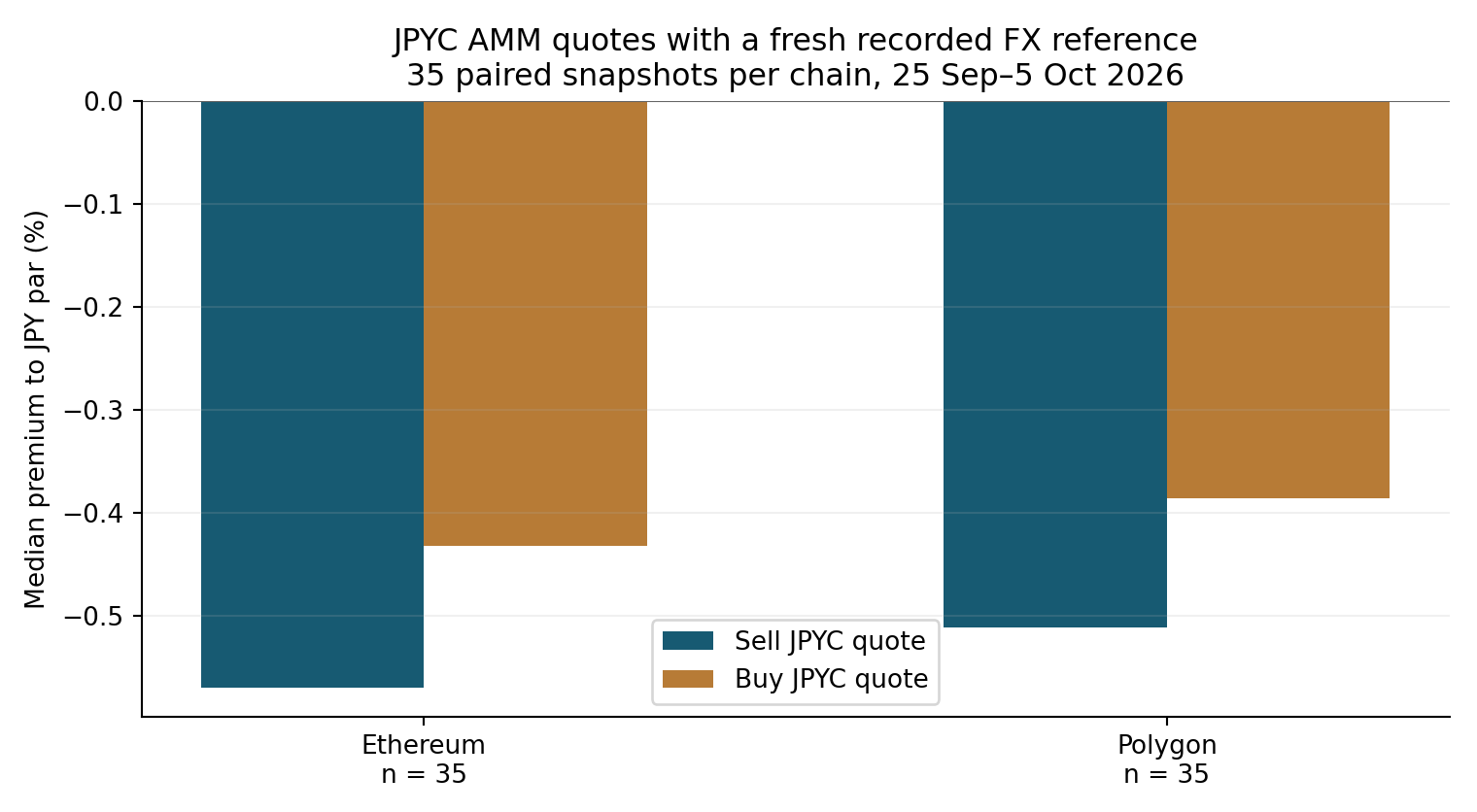
The retained sample shows median discounts in both directions and on both chains. Buying JPYC costs less than yen par under the normalization, while selling JPYC yields still less. The paired gap reflects the economics of crossing the quoted market at these request sizes.
The difference between chains is small compared with the additional variables required for a completed strategy. It cannot be interpreted as a realizable cross-chain profit: moving inventory incurs time and potentially costs, the routes were queried separately, and the precise inventory required on each side differs.
Likewise, the 0.432% median buy discount on Ethereum is not a statement that a million-yen redemption transaction earned 0.432%. The observed request spends 1,000 USDC; scaling it changes the price-impact problem. Redemption timing and subsequent costs were not observed in this market-data sample.
5. A complete accounting identity
Consider buying Q JPYC at an executed all-in market acquisition price p yen per token, then redeeming at par. Let C_fixed denote fixed route and payment costs, c_var proportional costs not already contained in p, and C_capital the economic cost of committed capital. Realized net value, if redemption completes at par, is:
net_JPY = Q × (1 − p) − C_fixed − Q × c_var − C_capital
Every term requires a consistent boundary. If p comes from the actual token input/output of a swap, pool fees and that swap's price impact are already reflected in the execution rate. Subtracting those same costs a second time understates the result. Gas, approvals, bridging, bank costs, and subsequent conversion may remain outside the rate, depending on the route.
KyberSwap's documentation distinguishes price impact due to the trade's size from slippage between an expected quotation and the realized result. That distinction is operationally useful: an old small-size quote cannot substitute for the current executable rate of a larger transaction. KyberSwap, Price Impact; Slippage.
The cost of a failed or reverted attempt also belongs in the economic boundary. A dataset containing only successful swaps systematically omits unsuccessful gas spending and the waiting time consumed by incomplete routes. A robust realized study would retain attempts and state transitions, then classify their eventual outcomes.
6. Constructed break-even scenarios
To demonstrate scale and delay without disclosing anyone's transactions, consider a hypothetical cost schedule:
- fixed costs of 1,500 yen;
- additional proportional costs of 15 basis points;
- an annual capital charge of 8%;
- committed capital approximated by JPYC face value over the waiting interval.
These values are chosen for illustration. They are not observed issuer fees, observed funding rates, or forecasts of processing time. With T calendar days and a 365-day convention, the break-even discount in basis points is:
d_break_even = 15 + 10,000 × 1,500 / Q + 10,000 × 0.08 × T / 365
| Hypothetical JPYC face value | One-day delay | Three-day delay | Seven-day delay |
|---|---|---|---|
| 100,000 yen | 167.19 bp | 171.58 bp | 180.34 bp |
| 1,000,000 yen | 32.19 bp | 36.58 bp | 45.34 bp |
| 5,000,000 yen | 20.19 bp | 24.58 bp | 33.34 bp |
Table 2. Constructed break-even discounts. The larger face values illustrate accounting scale and do not imply permitted single-request limits or executable depth.
At a hypothetical one-million-yen face value, the seven-day break-even discount is approximately 0.453%. That exceeds the retained Ethereum median buy discount of 0.432%. This comparison illustrates how an apparently favorable quote can be absorbed by costs. It is not a backtest because the cost assumptions, size, and delay are not matched to an observed transaction.
Increasing size reduces the fixed-cost term, but it can increase price impact, require multiple operational cycles, or exceed applicable limits. The table holds those effects constant only to isolate the arithmetic. A complete optimizer would use a size-dependent execution curve and route-specific eligibility constraints.
Capital cost is also distinct from financing expense. A trader using owned cash may incur no explicit borrowing payment while still assigning an opportunity cost to unavailable funds. A reader evaluating actual cash profit should separate paid costs from that economic charge.
7. Redemption is an operational state transition
The issuer's published process requires an account and a registered bank destination. Its direct redemption workflow also specifies conditions for wallet registration, network selection, reserved amount, and timely token transfer; supported linked-wallet workflows can differ. Completion is therefore a conditional operational process, not a consequence of observing a token transfer alone. JPYC, Redemption Procedure; Bank Account Registration.
A research dataset should distinguish reservation, token receipt, review, approval, bank instruction, and final bank credit where those states are observable. An on-chain transfer to a service-associated destination does not establish the exact time at which spendable yen reached the recipient's bank account.
Public blockchain data can establish transfer timing. It cannot automatically reveal the off-chain decision process or the user's banking outcome. The issuer's transaction-explanation material itself distinguishes transaction hash, status, timestamp, transfer details, and gas fee as chain-recorded fields. JPYC, Checking a Transaction.
This article consequently does not estimate average redemption time from token transfers. The delay scenarios remain explicit assumptions. Inferring completed redemption whenever tokens leave a wallet would create a false precision in both capital duration and profitability.
8. Why a discount can persist
The accounting framework supports several possible mechanisms without identifying their relative importance in this sample. Market participants may face different access conditions, chain inventories, transaction costs, or settlement constraints. Quoted liquidity may be insufficient at the size required to amortize fixed costs. A trader may also demand compensation for uncertain execution and processing time.
These explanations are hypotheses consistent with the framework, rather than conclusions demonstrated by the 35 quote observations. The archive lacks executed flows and user-level operational outcomes, so it cannot identify the marginal arbitrageur or prove that one specific bottleneck caused the observed discount.
A stronger empirical design would link independent quote requests at fixed intervals to aggregate redemption throughput, timestamped public service status, and subsequent market adjustments. It would preserve failed requests and identify whether quote availability changes around banking hours or network congestion. Personal transaction details would not be required to publish broad market results.
9. Reproducibility, limitations, and implications for data quality
This web article presents the quote aggregates, constructed cost scenarios, and figure. The source archive remains unchanged. Internal verification retains a checksum manifest and the coverage counts used to construct the analytical sample.
The reproducible procedure enumerates the saved snapshots, applies the recorded FX-source and age screen, selects the first AMM interval in both directions, converts the inverse quotations into yen premia, and computes unweighted medians by chain. No individual order rows, maker labels, account identifiers, or transaction records enter the public release.
The archive's main contribution is that it supports a falsifiable quote calculation with an explicit valuation assumption and denominator. Its main restriction is that the economic loop stops at the quote. Actual acquisition, redemption completion, and final cash receipt remain unobserved.
For a market-data product, preserving that boundary is part of research quality. A useful dataset should make it possible to distinguish indicative discounts, executable size-specific rates, and completed economic outcomes. Combining them into a single attractive return number would erase the very information needed to evaluate the opportunity.
References
-
JPYC. Redemption Procedure and Bank Account Registration. Official procedures, consulted 5 October 2026.
-
JPYC. Product and Company Disclosures and Checking a Transaction. Official materials, consulted 5 October 2026.
-
KyberSwap. DEX/DeFi Aggregator, Price Impact, and Slippage. Official documentation, consulted 5 October 2026.
-
Original archived public-liquidity route observations, 17 September–5 October 2026. Aggregate calculation referenced in this article: JPYC Quote Aggregates.
-
Author calculations under explicitly hypothetical cost assumptions. Constructed Cost Scenarios.
-
JPYC. Official Contract Notice and Token Display and Balance Instructions. Official deployment identity sources, checked 5 October 2026.