Equity Perpetuals Outside Primary-Market Hours: Measuring Basis Without Mistaking It for Price Discovery
An archival study of KIOXIA on Hyperliquid and the information needed to evaluate a 24-hour market
Data vintage 278 saved observations, 31 July–2 October 2026 UTC; 277 observations fall on 21 September–2 October
Abstract
An equity perpetual can continue trading while the primary stock exchange is closed. Interpreting its price requires separating the market's information content from the mechanics of its oracle and risk mark. This study examines 278 archived observations of the KIOXIA perpetual on Hyperliquid, classifying each by the Tokyo Stock Exchange calendar. Median absolute mark-to-oracle basis is 2.48 basis points during regular exchange sessions, 15.47 basis points during other business-day hours, and 12.07 basis points on weekends or exchange holidays. These are descriptive differences in a selected archive, dominated by twelve consecutive September–October observation dates. They do not establish that the perpetual forecasts the cash-market opening, because independent equity prices, external-price timestamps, and synchronized executable quotes are absent. The contribution is a reproducible session comparison and a framework that distinguishes internal price consistency, external price discovery, funding transfers, and corporate-action continuity. A sensitivity excluding the stock-split transition day preserves the ordering of the median basis measurements.
Keywords: Hyperliquid; HIP-3; equity perpetuals; price discovery; oracle; funding; trading sessions; corporate actions.
1. The research question
What can a continuously traded equity perpetual tell us while the primary stock exchange is closed, and which measurements are necessary to test whether that information is useful?
Two superficially similar questions must be evaluated independently. One asks whether the perpetual's mark remains close to its own oracle. The other asks whether trading improves the forecast of an independently observed stock price. A small mark-to-oracle gap addresses the first question. It cannot, by itself, answer the second.
The distinction matters because the oracle may draw on the perpetual market during periods without external pricing. In that state, a trader-influenced oracle and a market-influenced mark can move together. Their agreement is an observation about the mechanism's internal coherence. External validation requires a price that is not generated by that same feedback process.
The empirical exercise below deliberately starts with the observable relationship. It measures basis in one Japanese equity perpetual and makes the calendar classification explicit. It then identifies the missing inputs for testing price discovery, hedging costs, and market quality.
2. Institutional setting and measurement objects
2.1 One venue contains several economically different prices
Hyperliquid's market-information interfaces expose asset contexts, including mark price, oracle price, funding, and open interest. These fields describe different aspects of the market; a data pipeline should retain their original identities. The archive used here was collected from the asset-context interface for the relevant builder deployment. Hyperliquid, Info Endpoint.
The current trade[XYZ] documentation distinguishes an external price, an oracle, and a mark. Its external-price field retains the last externally derived fair price when external markets close. The oracle may continue updating through an internal mechanism. The mark combines multiple inputs and serves risk-management functions. trade[XYZ], External Price; Mark Price.
For analysis, this creates at least four price objects: an executable bid or ask; the risk mark; the funding-reference oracle; and the independently sourced equity price. The archive preserves the middle two. It does not preserve the other two with synchronized timestamps.
2.2 Primary-exchange closure is not the same as external-price unavailability
The Tokyo Stock Exchange's regular domestic-stock sessions run from 09:00 to 11:30 and 12:30 to 15:30 Japan Standard Time. Its published calendar also identifies weekends and exchange holidays. These rules define the empirical groups in this article. Japan Exchange Group, Trading Hours; Market Holidays.
Other venues can supply Japanese equity prices beyond those hours. The trade[XYZ] Japan specification, consulted during preparation, describes wider day and night external-coverage windows, as well as conversion of yen-denominated equity quotes into dollar prices. Consequently, the category “other business-day hours” is a primary-exchange calendar category. It cannot be interpreted as a direct observation that the oracle was operating internally. trade[XYZ], Japan Stocks.
This prevents a common classification error. A monitor that labels every non-TSE minute as “no external market” can combine external night-session trading, lunch breaks, genuine overnight closure, and exceptional trading arrangements. The present archive does not contain an oracle-mode flag that would resolve those states exactly.
3. Data and research design
3.1 Coverage
The source contains 278 timestamped rows with positive KIOXIA mark and oracle prices. No repeated observation timestamp was found. The first row is dated 31 July 2026; the remaining 277 rows begin on 21 September and end on 2 October. The full sample spans 13 distinct Japanese calendar dates.
This is not continuous coverage of the interval between July and October. There is one gap of approximately 1,237 hours between the July observation and the September segment. The median gap between consecutive saved rows is one hour. Only that long gap exceeds three hours. Reporting the date range alone would substantially overstate the temporal coverage.
Rows were retained according to availability in the archive, with no selection based on whether the observed basis supported a particular result. The July row remains in the descriptive dataset. Its presence does not turn the archive into a multimonth panel.
The collector timestamps a response after obtaining the builder's asset contexts. That timestamp is a collection timestamp. It is not a separately authenticated exchange event time or the publication time of the underlying external quote. Collection timing is adequate for broad session classification here, while leaving finer latency questions unresolved.
3.2 Calendar alignment
All timestamps are interpreted as UTC and converted to Asia/Tokyo. A row is assigned to exactly one category:
- TSE regular session: a business day, outside an exchange holiday, between 09:00 and 11:30 or between 12:30 and 15:30 JST.
- Other business-day hours: a nonholiday weekday outside those sessions.
- Weekend or holiday: Saturday, Sunday, or a published exchange holiday.
The implemented intervals include their opening boundary and exclude their closing boundary. The sample includes the September 21–23 holiday sequence, which must be classified explicitly rather than treated as ordinary weekdays. None of the resulting statistics measures the duration-weighted share of the entire calendar.
3.3 Basis and funding units
For saved observation t, the signed basis is:
basis_t = 10,000 × (mark_t / oracle_t − 1)
The unit is basis points. Positive values mean the mark is above the oracle. Absolute basis measures the size of their separation without cancellation between positive and negative observations.
Funding is converted from the stored decimal hourly rate into basis points per hour. The analysis reports the median observed rate; it does not multiply a sampled rate through an unobserved weekend or reconstruct a trader's funding receipts.
The current Hyperliquid documentation specifies hourly payments and distinguishes the funding calculation from a simple instantaneous mark/oracle ratio. Its HIP-3 framework allows contract-specific funding behavior. Applying a universal equality between observed basis and a multiple of the funding rate would therefore add an unsupported assumption. Hyperliquid, Funding.
4. Results
| Primary-market calendar category | Observations | Distinct JST dates | Median signed basis, bp | Median absolute basis, bp | 90th percentile absolute basis, bp |
|---|---|---|---|---|---|
| TSE regular session | 42 | 7 | 0.41 | 2.48 | 26.39 |
| Other business-day hours | 121 | 8 | 3.33 | 15.47 | 56.86 |
| Weekend or holiday | 115 | 5 | 1.38 | 12.07 | 39.96 |
Table 1. Original calculations from all retained observations. Date counts overlap across categories and must not be summed. Quantiles use linear interpolation between ordered observations.
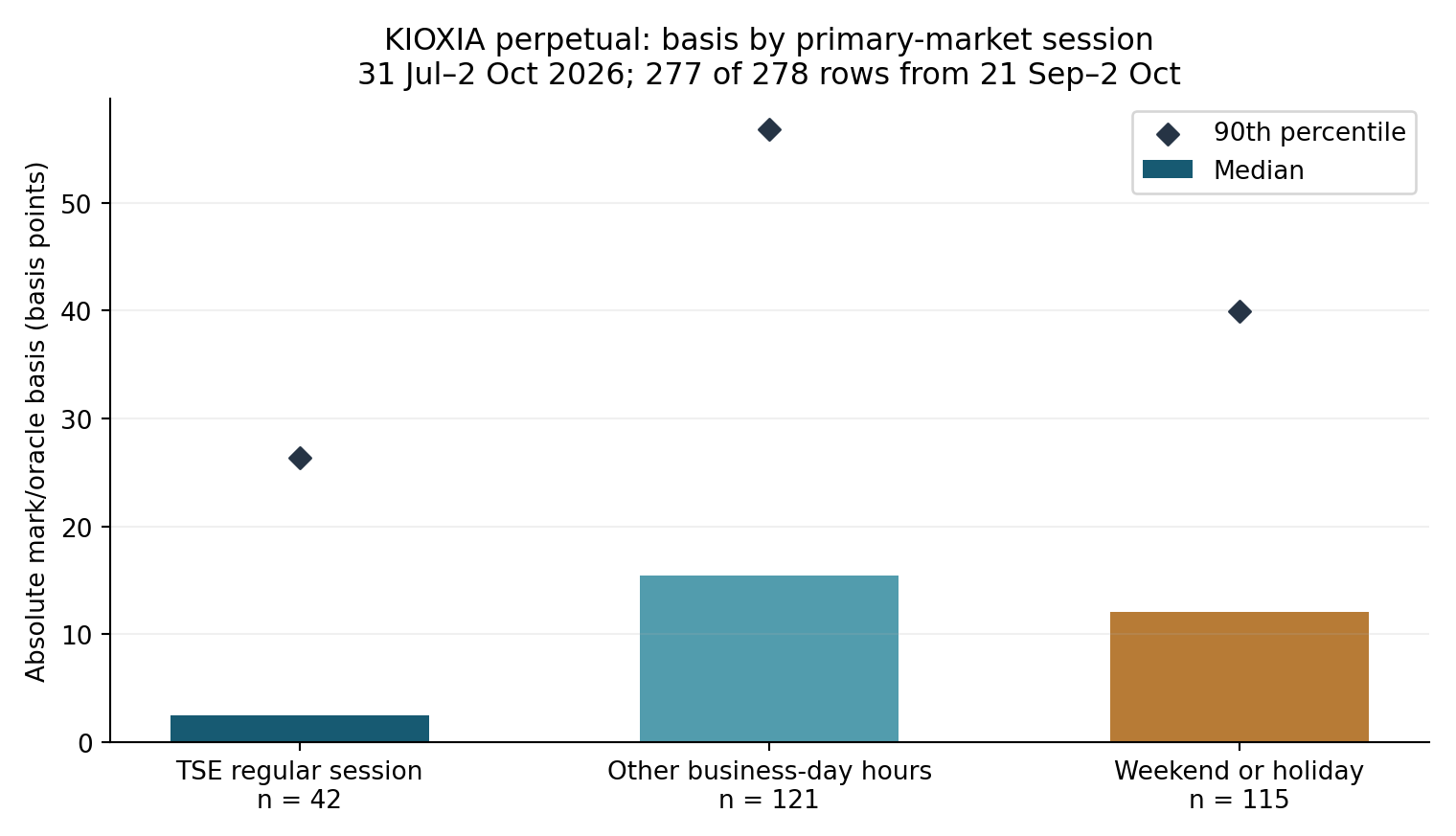
The descriptive pattern is clear within the archive: mark/oracle separation is smaller at the median during the primary exchange's regular sessions. The ranking also holds at the 90th percentile. The other-business-hours group has the largest reported separation at both summary points.
The median signed basis is much smaller than the median absolute basis in every category. This indicates why a signed average or median alone is inadequate for describing tracking dispersion. Positive and negative deviations convey direction, while absolute values measure distance.
Median hourly funding is approximately 0.062 basis points during TSE sessions, 0.164 basis points in other business-day hours, and 0.062 basis points on weekends or holidays. Those small medians coexist with appreciable absolute basis. There is no contradiction: funding and the displayed mark/oracle difference are separate observables with different construction and timing.
These numbers establish an archive-specific comparison. They do not establish a causal effect of exchange closure. The three groups contain different days, news conditions, liquidity conditions, and potentially different oracle regimes. Repeated hourly observations within the same day are also dependent. Treating 278 rows as 278 independent experiments would exaggerate the amount of evidence.
5. Corporate actions and a sensitivity test
The observation period crosses a stock-split transition. The published venue notice specified settlement of open KIOXIA positions, cancellation of orders, and reopening on a post-split share basis on 28 September. That procedure changes the economic continuity of a position, even though the market retains its instrument name. trade[XYZ], 2026-09-28: Kioxia Stock Split.
A raw price-return series spanning the transition could therefore confuse a change of share units with a loss of economic value. An open-interest series expressed in contract units is similarly unsafe to compare across the boundary without contract metadata. The present analysis uses a dimensionless within-row price ratio and does not calculate an unadjusted return across the split.
A ratio can still be affected by a transitional mismatch between mark and oracle, or by temporarily altered market conditions. To examine that concern, a sensitivity removes all observations on the Japanese calendar date of the corporate action, rather than selecting individual suspicious points.
| Calendar category | Observations after exclusion | Median absolute basis, bp |
|---|---|---|
| TSE regular session | 36 | 1.59 |
| Other business-day hours | 103 | 15.47 |
| Weekend or holiday | 115 | 12.07 |
Table 2. Sensitivity excluding 28 September 2026 JST. The ordering survives; this is not a separate independent sample.
The sensitivity supports the narrower conclusion that the descriptive ranking is not produced solely by retaining the transition day. It does not establish that all remaining observations have identical contract parameters or identical market regimes.
6. How to test price discovery properly
6.1 Define an independent target
A defensible forecasting test begins with a predetermined cash-market target: for example, an official opening-auction price or a fixed-window volume-weighted price after reopening. The target must be adjusted for corporate actions and use the same currency and share basis as the predictor.
Let C be the last independent closing price, P_pre the final eligible perpetual observation before the opening, and O the independent opening target. A basic comparison is:
baseline error = O − C
perpetual forecast error = O − P_pre
One can compare absolute errors or squared errors across distinct reopenings. Currency conversion must use a consistently defined FX observation, and the perpetual observation must be available before the target period begins. An equity price observed after reopening cannot be used to repair the predictor retrospectively.
The comparison should also include reasonable external alternatives. If another equity venue trades during the night, its last eligible price may contain the same information. A perpetual can predict the primary opening without being the first venue to discover that information.
6.2 Distinguish feedback from independent confirmation
The current trade[XYZ] oracle description states that, when external inputs are unavailable, its internal process adjusts using impact prices from the order book. A close association between that oracle and the perpetual mark may partly reflect their shared input structure. trade[XYZ], Oracle Price.
This gives a concrete identification problem. A test of whether the mark predicts its own oracle can reward mechanical adjustment even when neither series predicts an independent opening price. The appropriate target is therefore external, and the analysis should record when the mechanism changes from internal to external pricing.
Discovery bounds add another source of state dependence. Current documentation describes limits and possible re-anchoring governed by market parameters. A value at a configured boundary may represent a constrained observation. Parameter history is necessary before interpreting repeated boundary prices as the absence of further information. trade[XYZ], Discovery Bounds.
6.3 Use the reopening as the statistical unit
A forecast made at twenty hourly points before the same opening supplies twenty related forecasts of one outcome. It does not supply twenty independent opening events. A prospective study should define one or a small number of fixed horizons per reopening and evaluate uncertainty at the event or day level.
The available archive contains too few distinct dates and lacks the independent targets required for that exercise. No predictive correlation, forecast-improvement percentage, or statistical significance claim is reported here.
7. Price discovery and executable market quality
A price may be informative while difficult to trade. Conversely, a market may provide inexpensive execution near an internally constructed reference without adding much information about the next stock-market opening. Data buyers need both dimensions.
An executable comparison would retain the best bid and ask, depth at predetermined sizes, and realized fills where available. It would price a specified round trip, including fees, funding payments during the holding interval, external-hedge costs, and currency exposure. A mark price is not a commitment by a counterparty to fill that round trip.
For a non-dollar stock, the unit conversion also deserves explicit treatment. A dollar-denominated perpetual can change when the stock's yen price changes, when USD/JPY changes, or when both move. Comparing it with a stale yen quote can misattribute an FX move to equity-specific information. A dataset should preserve the raw equity reference and raw FX input in addition to the converted dollar value.
None of those missing components can be reconstructed from a wider mark/oracle basis alone. The basis statistic is useful precisely because its meaning is limited and reproducible.
8. Reproducibility, limitations, and released material
This web article presents the session aggregates in Table 1, the funding summaries, and the figure. Internal calculation records retain the input checksum, coverage diagnostics, and the corporate-action sensitivity. No account or trading-performance records are used.
Reproduction proceeds by parsing the saved UTC timestamps, converting them to Japan time, applying the published regular-session calendar, computing each row's ratio, and calculating unweighted sample quantiles within the three categories. Missing dates are retained as missing coverage. No forward fill or interpolation is applied.
The most important limitations are economic rather than numerical. The sample covers one instrument; collection is selected and asynchronous; actual oracle modes and source timestamps are not retained; the external opening target is absent; and current documentation cannot certify every historical parameter. These restrictions prevent market-wide, causal, or predictive claims.
What the archive does establish is a measurable difference in internal price separation across primary-market calendar states. A stronger dataset can build on that baseline by preserving external prices, operating modes, execution depth, and corporate-action versions. Those additions turn a continuous chart into evidence that can support a test of continuous price discovery.
References
- Hyperliquid. Info Endpoint and Funding. Official documentation, consulted 5 October 2026.
- trade[XYZ]. Oracle Price, Mark Price, and External Price. Official documentation, consulted 5 October 2026.
- trade[XYZ]. Japan Stocks and Discovery Bounds. Official documentation, consulted 5 October 2026.
- trade[XYZ]. 2026-09-28: Kioxia Stock Split. Official corporate-action notice.
- Japan Exchange Group. Trading Hours and Market Holidays. Official calendar and session definitions, consulted 5 October 2026.
- Original archived asset-context observations. Aggregate calculation referenced in this article: Equity Session Aggregates, calculated 5 October 2026.